<?xml version="1.0" encoding="UTF-8"?><feed
	xmlns="http://www.w3.org/2005/Atom"
	xmlns:thr="http://purl.org/syndication/thread/1.0"
	xml:lang="en-US"
	>
	<title type="text">wsiexpertosweb</title>
	<subtitle type="text"></subtitle>

	<updated>2026-06-03T18:14:24Z</updated>

	<link rel="alternate" type="text/html" href="https://www.wsiexpertosweb.com/" />
	<id>https://www.wsiexpertosweb.com/feed/atom/</id>
	<link rel="self" type="application/atom+xml" href="https://www.wsiexpertosweb.com/feed/atom/" />

	<generator uri="https://wordpress.org/" version="7.0">WordPress</generator>
<icon>https://www.wsiexpertosweb.com/wp-content/uploads/2024/10/cropped-cropped-wsiworld-favicon2017-180x180-1-32x32.webp</icon>
	<entry>
		<author>
			<name>Expertos-Shield</name>
							<uri>https://www.wsiexpertosweb.com</uri>
						</author>

		<title type="html"><![CDATA[Human Content Strategy: Why AI Volume Alone Does Not Generate Leads or Conversions]]></title>
		<link rel="alternate" type="text/html" href="https://www.wsiexpertosweb.com/blog/human-content-strategy-why-ai-alone-does-not-convert/" />

		<id>https://www.wsiexpertosweb.com/?p=7356</id>
		<updated>2026-06-03T18:14:24Z</updated>
		<published>2026-06-03T17:08:50Z</published>
		<category scheme="https://www.wsiexpertosweb.com/" term="Artificial Intelligence" /><category scheme="https://www.wsiexpertosweb.com/" term="Blog" /><category scheme="https://www.wsiexpertosweb.com/" term="Digital marketing" /><category scheme="https://www.wsiexpertosweb.com/" term="Digital Strategy" /><category scheme="https://www.wsiexpertosweb.com/" term="AI content" /><category scheme="https://www.wsiexpertosweb.com/" term="content marketing" /><category scheme="https://www.wsiexpertosweb.com/" term="E-E-A-T" /><category scheme="https://www.wsiexpertosweb.com/" term="eeat" /><category scheme="https://www.wsiexpertosweb.com/" term="human content strategy" /><category scheme="https://www.wsiexpertosweb.com/" term="inbound marketing" /><category scheme="https://www.wsiexpertosweb.com/" term="lead generation" /><category scheme="https://www.wsiexpertosweb.com/" term="thought leadership" />
		<summary type="html"><![CDATA[<p>A human content strategy has become the primary differentiator in digital marketing. AI has made it possible to produce content faster than ever before. The result is that most industries now have more content than they need, and very little of it actually converts. The businesses gaining ground in 2026 are not the ones publishing [&#8230;]</p>
<p>The post <a href="https://www.wsiexpertosweb.com/blog/human-content-strategy-why-ai-alone-does-not-convert/">Human Content Strategy: Why AI Volume Alone Does Not Generate Leads or Conversions</a> appeared first on <a href="https://www.wsiexpertosweb.com">wsiexpertosweb</a>.</p>
]]></summary>

					<content type="html" xml:base="https://www.wsiexpertosweb.com/blog/human-content-strategy-why-ai-alone-does-not-convert/"><![CDATA[<p>A human content strategy has become the primary differentiator in digital marketing. AI has made it possible to produce content faster than ever before. The result is that most industries now have more content than they need, and very little of it actually converts. The businesses gaining ground in 2026 are not the ones publishing the most. They are the ones publishing content that AI cannot replicate.</p>
<p>A Semrush study published in April 2026, analyzing 42,000 blog posts across 20,000 keywords, found that human-written content occupies the top position on Google 80% of the time. Purely AI-generated content without human editing and strategic oversight consistently underperforms. The volume advantage AI provides is real. The conversion advantage stays with human expertise.</p>
<p>This post examines what a human content strategy actually provides that AI cannot, and why the gap between content volume and content performance is widening for businesses that have not made that distinction yet.</p>
<h2>Why a human content strategy outperforms volume in 2026</h2>
<p>AI produces content that is structurally sound, grammatically clean, and SEO-formatted. It covers topics accurately. It is also easy to ignore.</p>
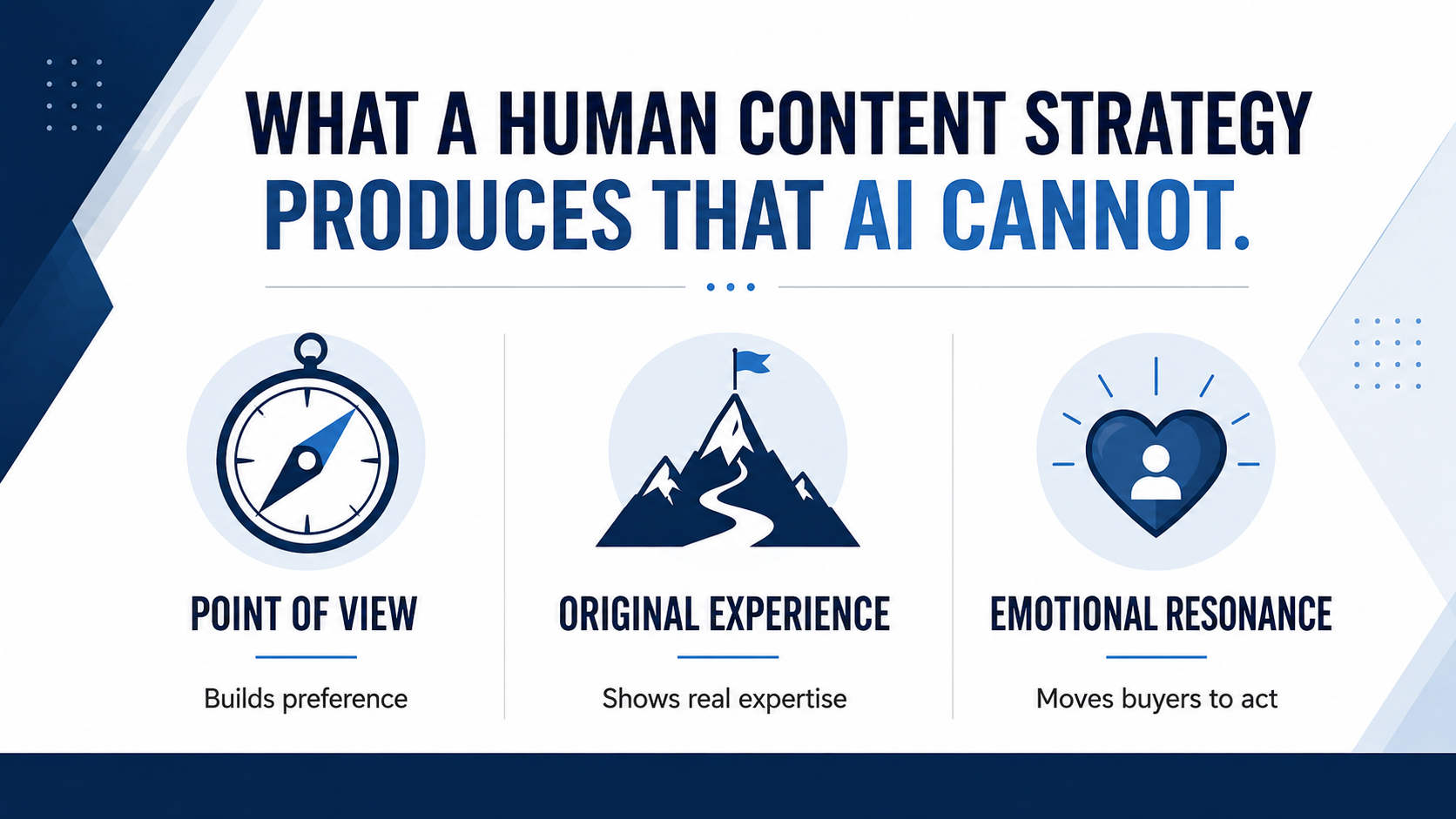
<div id="attachment_7357" style="width: 1156px" class="wp-caption alignnone"><img wpfc-lazyload-disable="true" fetchpriority="high" decoding="async" aria-describedby="caption-attachment-7357" class=" wp-image-7357" src="https://www.wsiexpertosweb.com/wp-content/uploads/2026/06/ChatGPT-Image-3-jun-2026-11_03_14-a.m.-2.png" alt="Infographic showing that a human content strategy produces point of view, original experience, and emotional resonance that AI cannot replicate" width="1146" height="645" srcset="https://www.wsiexpertosweb.com/wp-content/uploads/2026/06/ChatGPT-Image-3-jun-2026-11_03_14-a.m.-2-980x552.png 980w, https://www.wsiexpertosweb.com/wp-content/uploads/2026/06/ChatGPT-Image-3-jun-2026-11_03_14-a.m.-2-480x270.png 480w" sizes="(min-width: 0px) and (max-width: 480px) 480px, (min-width: 481px) and (max-width: 980px) 980px, (min-width: 981px) 1146px, 100vw" /><p id="caption-attachment-7357" class="wp-caption-text">Human expertise creates the signals that help content build trust and move buyers to act.</p></div>
<p>When multiple businesses use similar prompts and datasets, the output converges. Topics get covered. Points get accurate. The content becomes interchangeable. A buyer reading it cannot tell who produced it, which means it does not build any preference for the brand that published it.</p>
<p>The <a href="https://contentmarketinginstitute.com/b2b-research/b2b-content-marketing-trends-research">Content Marketing Institute&#8217;s B2B research for 2026</a> found that businesses producing content without genuine expert involvement see weaker lead quality and longer sales cycles, even when traffic stays stable. The problem does not show up as a visibility issue. It shows up as a conversion issue.</p>
<h3>The discoverability crisis AI volume creates</h3>
<p>AI search platforms like ChatGPT and Perplexity now evaluate content on topical depth, author credibility, and genuine query resolution. They do not run a simple link graph. Generic content that covers a topic without adding original perspective or real expertise rarely gets cited.</p>
<p>A human content strategy built around demonstrated expertise earns citations. That is the visibility advantage that matters now, not keyword density or publication frequency.</p>
<h2>What a human content strategy actually produces that AI cannot</h2>
<p>The distinction is not about speed or volume. It is about what drives a reader to take action after reading.</p>
<h3>Genuine point of view builds preference</h3>
<p>AI synthesizes what already exists. It cannot hold an opinion based on lived experience, offer a perspective shaped by working directly with clients, or challenge conventional thinking from a position of earned credibility.</p>
<p>Content with a genuine point of view creates preference. Buyers remember a perspective that surprised them or confirmed something they suspected but had not seen articulated. Generic coverage of a topic leaves no trace.</p>
<h3>Original experience signals the expertise buyers need to trust</h3>
<p>Google&#8217;s E-E-A-T framework now includes Experience as its leading signal. Content that demonstrates real-world involvement in a topic performs better than content that describes a topic from the outside.</p>
<p>That experience signal cannot be generated. It has to be contributed by the people who have it. A consultant who has worked through a specific business problem, a practitioner who has run the campaigns, a leader who has seen the pattern across clients: their perspective is the content asset that AI cannot replicate.</p>
<p>The <a href="https://contentmarketinginstitute.com/strategy-planning/trends-content-marketing">Content Marketing Institute&#8217;s 2026 trends research</a> puts it directly: authenticity is the number one content asset businesses hold in 2026. The marketers who gather human expertise from their people and publish it consistently are building something that compounds over time.</p>
<h3>Emotional resonance determines whether content moves buyers</h3>
<p>Buying decisions are emotional. Buyers rationalize with data but decide with feeling. Content that understands the reader&#8217;s actual fear, frustration, or aspiration at the moment they are reading converts. Content that describes their situation from a distance does not.</p>
<p>AI does not experience the emotional context of a decision. It can describe it. Human writers who understand their clients deeply can write from inside it. That difference is what separates content that generates inquiries from content that produces pageviews.</p>
<h2>The human content strategy gap most businesses have not closed</h2>
<p>The CMI&#8217;s B2B research found that only 5% of employees with specialized knowledge actively contribute to content programs. That means 95% of a company&#8217;s real expertise sits outside the content it publishes.</p>
<p>The pacesetters in B2B content show 24% employee participation in thought leadership versus 18% overall. They also measure differently. Seventy-five percent of top performers track business impact from content, not just clicks. Fifty-one percent track brand authority. They treat their human content strategy as a business asset, not a traffic mechanism.</p>
<p>Organizations that have not closed this gap are essentially publishing commoditized information under their brand name. They look active. They do not look authoritative. In a market flooded with AI-produced content, authority is the only differentiator that creates real commercial preference.</p>
<h3>The hybrid approach that actually scales</h3>
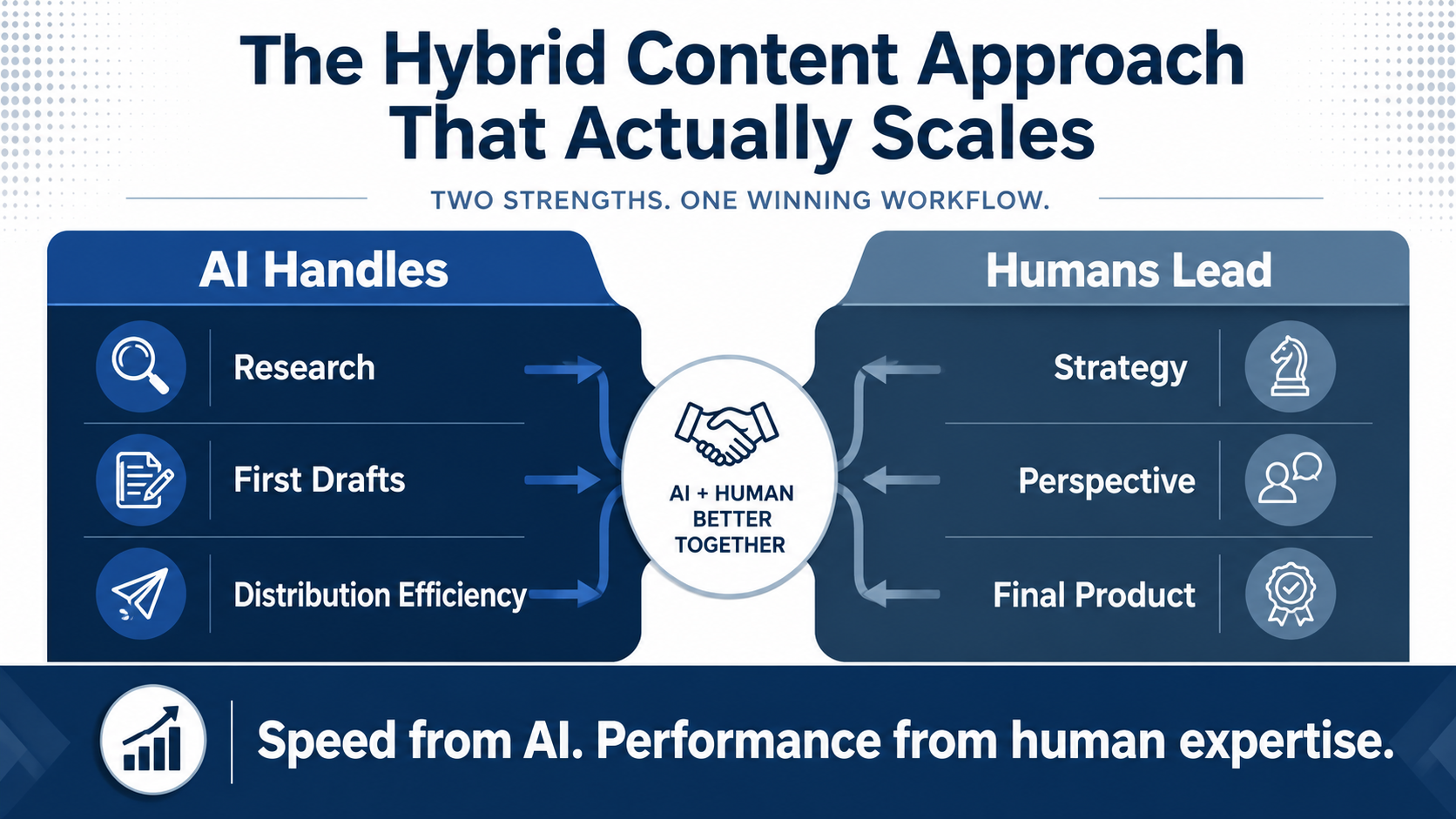
<p>The businesses producing the strongest content in 2026 use AI for research, structure, and distribution efficiency. They use human expertise for strategy, perspective, and the final product. AI makes the system faster. Human judgment keeps the output worth reading.</p>
<div id="attachment_7358" style="width: 1204px" class="wp-caption alignnone"><img wpfc-lazyload-disable="true" decoding="async" aria-describedby="caption-attachment-7358" class=" wp-image-7358" src="https://www.wsiexpertosweb.com/wp-content/uploads/2026/06/ChatGPT-Image-3-jun-2026-11_03_14-a.m.-3.png" alt="Diagram showing a hybrid content approach where AI handles research, first drafts, and distribution efficiency while humans lead strategy, perspective, and final product" width="1194" height="672" srcset="https://www.wsiexpertosweb.com/wp-content/uploads/2026/06/ChatGPT-Image-3-jun-2026-11_03_14-a.m.-3-980x552.png 980w, https://www.wsiexpertosweb.com/wp-content/uploads/2026/06/ChatGPT-Image-3-jun-2026-11_03_14-a.m.-3-480x270.png 480w" sizes="(min-width: 0px) and (max-width: 480px) 480px, (min-width: 481px) and (max-width: 980px) 980px, (min-width: 981px) 1194px, 100vw" /><p id="caption-attachment-7358" class="wp-caption-text">The best content systems use AI for speed and human expertise for performance.</p></div>
<p>That is not a philosophical position. It is a performance position. Human content strategy built on genuine expertise earns citations in AI search, builds the authority signals that drive organic visibility, and produces the conversion quality that justifies continued investment.</p>
<p>We covered the authority dimension of this in our post on <a href="https://www.wsiexpertosweb.com/blog/authority-in-ai-search-trust-signals-visibility/">what drives trust signals in AI search</a>, and the content structure side in our post on <a href="https://www.wsiexpertosweb.com/blog/optimize-content-for-ai-search-2026/">how to optimize content for AI search in 2026</a>.</p>
<h2>How WSI builds human content strategies that generate leads</h2>
<p>Building a human content strategy that converts requires more than a content calendar. It requires a clear picture of who the buyer is, what they need to believe before they contact you, and which formats and topics draw out the kind of genuine expertise that builds trust.</p>
<p>Our <a href="https://www.wsiexpertosweb.com/our-services/inbound/">inbound marketing work</a> builds content programs around exactly that structure. We start with the buyer, map the decision journey, identify where genuine expertise creates the most commercial influence, and build the content system that delivers it consistently.</p>
<p>Our <a href="https://www.wsiexpertosweb.com/our-services/digital-strategy/">digital strategy service</a> connects the content program to revenue objectives, ensuring that what gets published serves a clear business outcome rather than just generating traffic.</p>
<p>For organizations that also want their content to perform in AI search environments, our <a href="https://www.wsiexpertosweb.com/our-services/adaptive-search-everywhere-optimization/">Adaptive Search Everywhere Optimization</a> ensures that the expertise built into the content also earns visibility across ChatGPT, Perplexity, and Google AI Overviews.</p>
<h2>Frequently Asked Questions</h2>
<h3>What is a human content strategy?</h3>
<p>A human content strategy is a content program built around genuine expertise, original perspective, and real experience rather than AI-generated volume. It prioritizes content that demonstrates the organization&#8217;s specific knowledge, builds trust with buyers, and earns citations in AI search environments where authority determines visibility.</p>
<h3>Does AI have a role in a human content strategy?</h3>
<p>Yes. AI handles research, first drafts, formatting, and distribution efficiency. It makes the production process faster without lowering the quality bar. The human contribution is strategy, perspective, and the final product. That division of responsibility is what allows content to scale without becoming generic.</p>
<h3>Why does human-written content convert better than AI-only content?</h3>
<p>Human content strategy converts better because it creates preference. Buyers choose businesses they trust, and trust is built through demonstrated expertise, genuine perspective, and emotional resonance. AI-generated content that covers a topic accurately but impersonally does not build that preference. It fills a page without moving a buyer.</p>
<h3>How does human content strategy affect AI search visibility?</h3>
<p>AI search platforms like ChatGPT and Perplexity evaluate topical depth, author credibility, and query resolution quality. Content with genuine expertise, original data, and clear authority signals gets cited. Generic content produced without expert involvement rarely earns citation in AI-generated answers. A human content strategy is therefore also an AI visibility strategy.</p>
<p><strong>If your content is generating traffic but not the leads and conversions your business needs, the WSI team can help you build a human content strategy that closes that gap. </strong><a href="https://www.wsiexpertosweb.com/contact/">Start the conversation here.</a></p>
<p>The post <a href="https://www.wsiexpertosweb.com/blog/human-content-strategy-why-ai-alone-does-not-convert/">Human Content Strategy: Why AI Volume Alone Does Not Generate Leads or Conversions</a> appeared first on <a href="https://www.wsiexpertosweb.com">wsiexpertosweb</a>.</p>
]]></content>
		
			</entry>
		<entry>
		<author>
			<name>Expertos-Shield</name>
							<uri>https://www.wsiexpertosweb.com</uri>
						</author>

		<title type="html"><![CDATA[AI Search Content Strategy: Why Surface-Level SEO Is Losing Ground]]></title>
		<link rel="alternate" type="text/html" href="https://www.wsiexpertosweb.com/blog/ai-search-content-strategy/" />

		<id>https://www.wsiexpertosweb.com/?p=7347</id>
		<updated>2026-05-29T17:48:37Z</updated>
		<published>2026-05-29T17:48:37Z</published>
		<category scheme="https://www.wsiexpertosweb.com/" term="Artificial Intelligence" /><category scheme="https://www.wsiexpertosweb.com/" term="Blog" /><category scheme="https://www.wsiexpertosweb.com/" term="Digital Strategy" /><category scheme="https://www.wsiexpertosweb.com/" term="adaptive seo" /><category scheme="https://www.wsiexpertosweb.com/" term="AI search content strategy" /><category scheme="https://www.wsiexpertosweb.com/" term="AI search optimization" /><category scheme="https://www.wsiexpertosweb.com/" term="AI search visibility" /><category scheme="https://www.wsiexpertosweb.com/" term="brand authority" /><category scheme="https://www.wsiexpertosweb.com/" term="content for AI search" /><category scheme="https://www.wsiexpertosweb.com/" term="digital marketing strategy" /><category scheme="https://www.wsiexpertosweb.com/" term="surface-level SEO" />
		<summary type="html"><![CDATA[<p>AI search content strategy is becoming a serious visibility issue for businesses. Basic answers are easier for AI systems to summarize. Buyers now expect context, proof, and perspective before choosing who to contact. That changes what useful content needs to do. A page can still be technically optimized and still feel too shallow to influence [&#8230;]</p>
<p>The post <a href="https://www.wsiexpertosweb.com/blog/ai-search-content-strategy/">AI Search Content Strategy: Why Surface-Level SEO Is Losing Ground</a> appeared first on <a href="https://www.wsiexpertosweb.com">wsiexpertosweb</a>.</p>
]]></summary>

					<content type="html" xml:base="https://www.wsiexpertosweb.com/blog/ai-search-content-strategy/"><![CDATA[<p>AI search content strategy is becoming a serious visibility issue for businesses. Basic answers are easier for AI systems to summarize. Buyers now expect context, proof, and perspective before choosing who to contact.</p>
<p>That changes what useful content needs to do. A page can still be technically optimized and still feel too shallow to influence a buyer.</p>
<p>The risk is simple. If your content only repeats what everyone else says, AI can compress it into a summary. Your brand may never become the source buyers want to explore next.</p>
<h2>Why AI Search Content Strategy Matters Now</h2>
<p><a href="https://searchengineland.com/google-nick-fox-ai-search-deeper-content-478686">Search Engine Land reported that Google’s Nick Fox said AI search rewards content that goes deeper</a>. His point was not that SEO has changed into something unrelated. The standard for usefulness has changed.</p>
<p>AI systems can answer surface-level questions quickly. That means businesses need content that helps buyers think through the next question.</p>
<p>Those questions are rarely simple. Buyers compare options, weigh risks, look for proof, and check whether a business understands their situation. Thin content cannot carry that work.</p>
<p><a href="https://developers.google.com/search/docs/appearance/ai-features">Google Search Central explains that the same Search foundations still apply to AI features</a>, including helpful content, technical eligibility, structured information, and strong page experience. The difference is how much harder generic content has to work now.</p>
<h2>The Problem With Surface-Level SEO</h2>
<p>Many businesses still create content for the old version of search. They answer a keyword. They define a topic. They add a few examples. Then they move on to the next page.</p>
<p>That approach can create volume. It does not always create authority.</p>
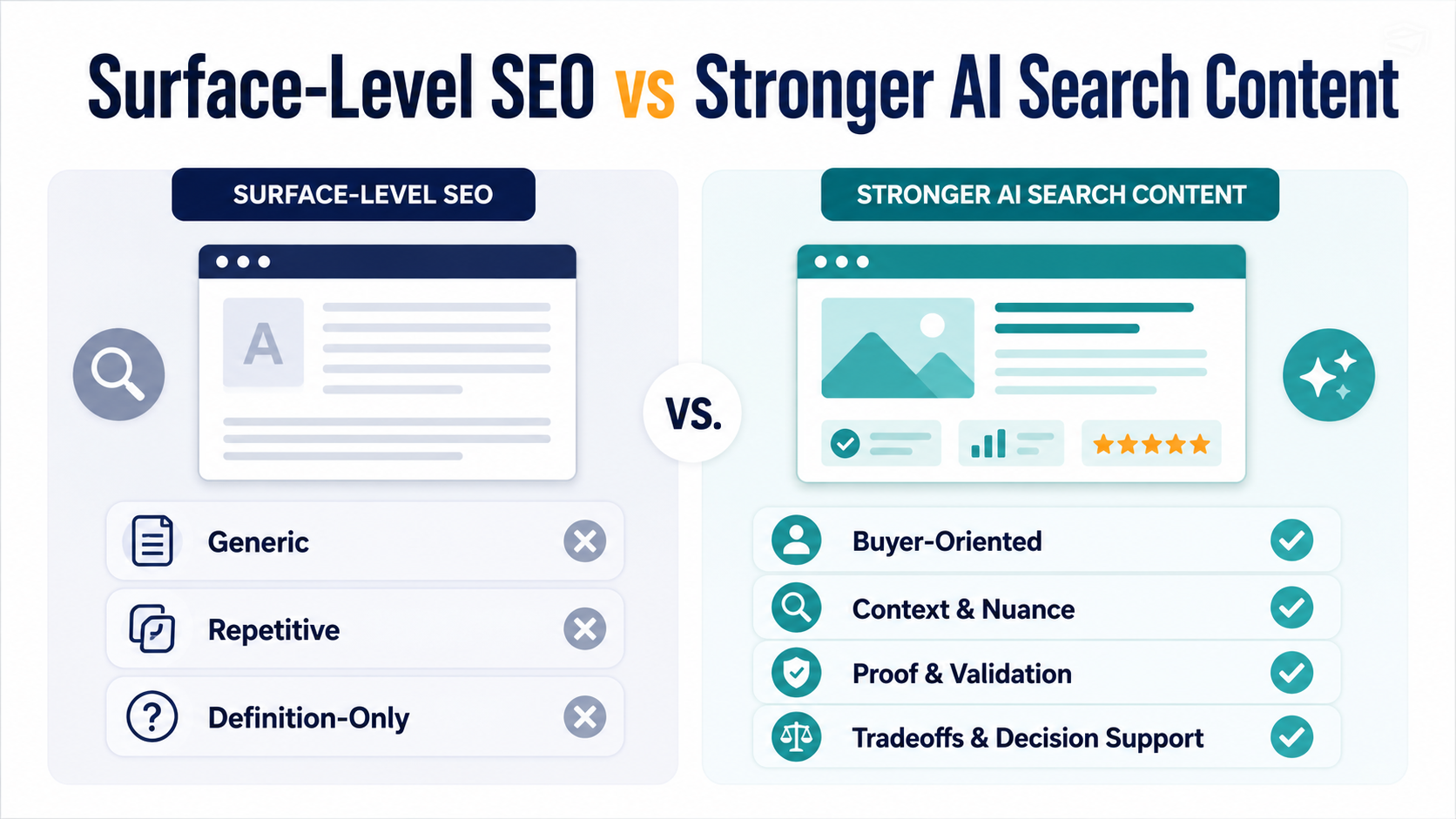
<p>Surface-level SEO usually has three weaknesses:</p>
<ul>
<li>It repeats information buyers can find anywhere.</li>
<li>It lacks a clear point of view.</li>
<li>It does not help buyers make a decision.</li>
</ul>
<p>This becomes more dangerous when AI answers sit between the buyer and the website. If the basic answer already appears in an AI result, your page needs to offer a stronger reason to be visited.</p>
<div id="attachment_7349" style="width: 979px" class="wp-caption alignnone"><img wpfc-lazyload-disable="true" loading="lazy" decoding="async" aria-describedby="caption-attachment-7349" class=" wp-image-7349" src="https://www.wsiexpertosweb.com/wp-content/uploads/2026/05/ChatGPT-Image-29-may-2026-11_31_26-a.m.-2.png" alt="Comparison of surface-level SEO and stronger AI search content showing how buyer-oriented content with proof, context, and decision support improves AI visibility" width="969" height="545" /><p id="caption-attachment-7349" class="wp-caption-text">Surface-level SEO may get noticed, but stronger content earns trust and visibility.</p></div>
<p>We covered this shift from another angle in our post on <a href="https://www.wsiexpertosweb.com/blog/zero-click-search-strategy-businesses-2026/">zero-click search strategy</a>, where buyers choose before they ever reach a website.</p>
<h3>Deeper does not mean longer</h3>
<p>Length is not the point. A long article can still be weak if it repeats the same idea.</p>
<p>Deeper content adds value through specificity. It explains tradeoffs. It uses real questions. It shows why a topic matters for a business decision.</p>
<p><a href="https://www.searchenginejournal.com/googles-old-search-era-is-over-heres-what-2026-seo-will-really-look-like/561410/">Search Engine Journal noted that content AI cannot easily replicate is driving results</a>, including experience-based commentary, data-rich insight, and human perspective.</p>
<h2>What Buyers Expect From Stronger Content</h2>
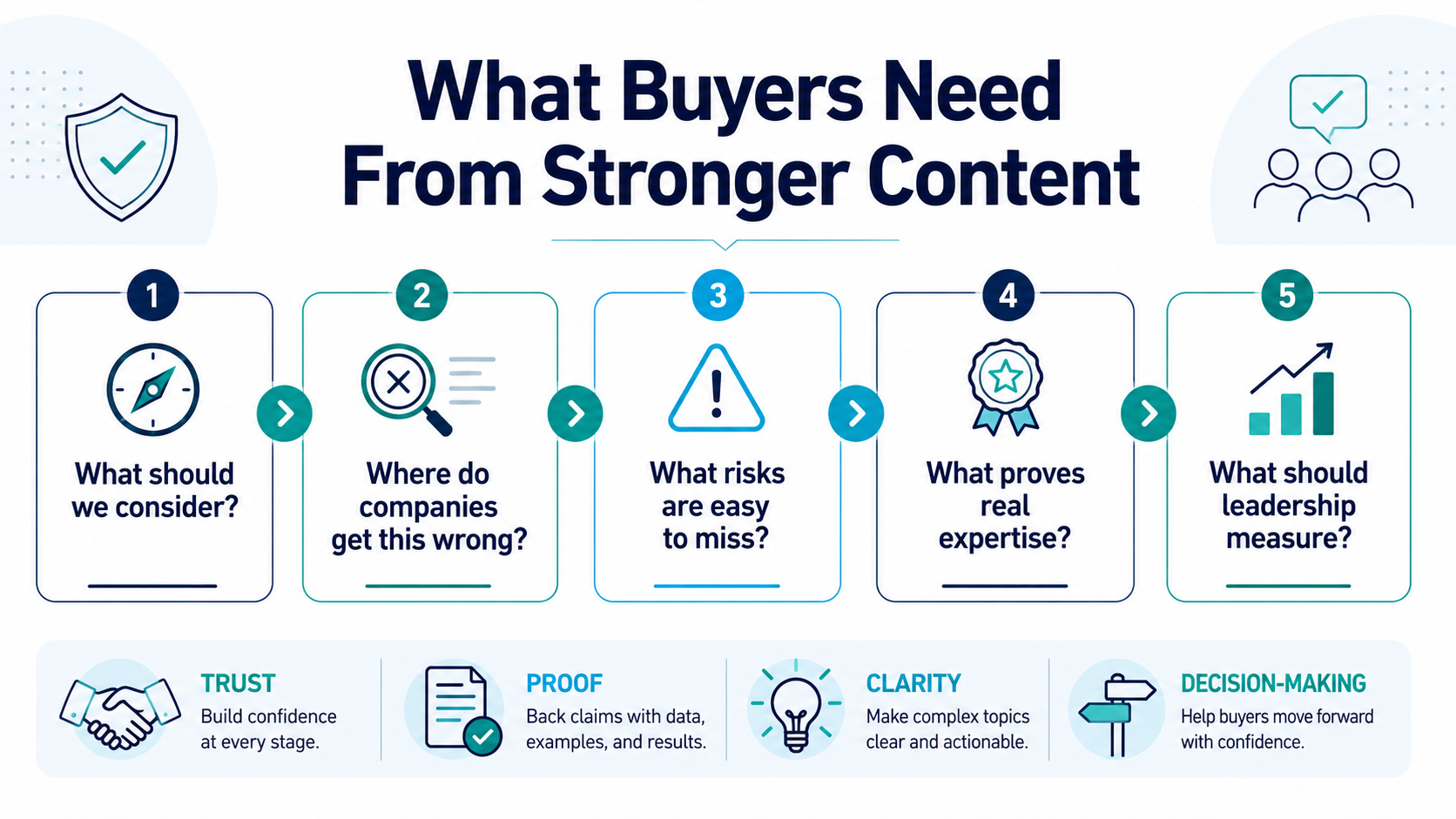
<p>Buyers do not want another generic overview. They want help reducing uncertainty.</p>
<p>That usually means content needs to answer questions like these:</p>
<ul>
<li>What should we consider before making this decision?</li>
<li>Where do companies usually get this wrong?</li>
<li>What risks are easy to underestimate?</li>
<li>What signals show that a provider understands the problem?</li>
<li>What should leadership measure before investing further?</li>
</ul>
<div id="attachment_7350" style="width: 996px" class="wp-caption alignnone"><img wpfc-lazyload-disable="true" loading="lazy" decoding="async" aria-describedby="caption-attachment-7350" class=" wp-image-7350" src="https://www.wsiexpertosweb.com/wp-content/uploads/2026/05/ChatGPT-Image-29-may-2026-11_31_26-a.m.-3.png" alt="Buyer decision framework showing the questions business buyers need answered before choosing a provider in AI-driven search environments" width="986" height="555" srcset="https://www.wsiexpertosweb.com/wp-content/uploads/2026/05/ChatGPT-Image-29-may-2026-11_31_26-a.m.-3-980x552.png 980w, https://www.wsiexpertosweb.com/wp-content/uploads/2026/05/ChatGPT-Image-29-may-2026-11_31_26-a.m.-3-480x270.png 480w" sizes="(min-width: 0px) and (max-width: 480px) 480px, (min-width: 481px) and (max-width: 980px) 980px, (min-width: 981px) 986px, 100vw" /><p id="caption-attachment-7350" class="wp-caption-text">Stronger content helps buyers reduce uncertainty before they decide who to contact.</p></div>
<p>These questions are more commercial than informational. They sit closer to evaluation. That is why they matter.</p>
<p>When AI search changes how people discover businesses, content must support both discovery and trust. Our article on <a href="https://www.wsiexpertosweb.com/blog/authority-in-ai-search-trust-signals-visibility/">authority in AI search</a> explains why trust signals now shape visibility.</p>
<h2>How AI Search Content Strategy Changes the Standard</h2>
<p>AI systems do not only look for a page that mentions the right topic. They also need enough clarity to understand the role your business plays in that topic.</p>
<p><a href="https://ahrefs.com/blog/seo-best-practices/">Ahrefs recommends clear structure, direct answers, and question-led sections for AI visibility</a>. That structure helps, but structure alone is not enough.</p>
<p>A page also needs substance. It should show that the business understands the buyer, the market, and the decision behind the search.</p>
<p>This is where many content programs stall. They publish often, but their pages do not build enough differentiation. They sound correct, but not useful enough to be chosen.</p>
<p><a href="https://searchengineland.com/stand-out-ai-search-every-business-sounds-same-478100">Search Engine Land has argued that AI builds a brand narrative from every digital signal a business publishes</a>. Generic content makes that narrative weaker.</p>
<h2>Where Businesses Should Start Looking</h2>
<p>The first step is not writing more content. It is understanding where your current content feels thin, outdated, or disconnected from buyer questions.</p>
<p>A few warning signs usually appear early:</p>
<ul>
<li>Important service pages explain what you do but not why it matters.</li>
<li>Blog posts answer definitions but avoid buyer concerns.</li>
<li>Content does not connect to proof, authority, or third-party validation.</li>
<li>Pages rank for keywords but do not support qualified conversations.</li>
<li>Your strongest expertise exists in sales calls, not on your website.</li>
</ul>
<p>This is why a content issue often becomes a strategy issue. Businesses need to know which pages deserve deeper treatment and which pages should not be expanded.</p>
<p>Our <a href="https://www.wsiexpertosweb.com/our-services/audit-and-diagnosis/">audit and diagnosis service</a> helps identify those gaps before teams invest more effort in content that may not move the business forward.</p>
<h2>How WSI Helps Build an AI Search Content Strategy</h2>
<p>At WSI Expertos Web, we approach AI search content strategy as part of a broader visibility strategy. The goal is not to produce longer articles. The goal is to build content that buyers and AI systems can understand, trust, and connect to business needs.</p>
<p>Our <a href="https://www.wsiexpertosweb.com/our-services/adaptive-search-everywhere-optimization/">Adaptive Search Everywhere Optimization</a> work focuses on visibility across traditional search, AI-powered platforms, and emerging discovery environments. It also addresses content clarity, authority signals, structured information, and continuous adaptation.</p>
<p>For companies that need to understand how AI affects marketing, operations, and customer discovery, our <a href="https://www.wsiexpertosweb.com/our-services/ai-consultants/">AI consulting work</a> helps connect strategy with practical next steps.</p>
<p>The right content strategy should not simply chase keywords. It should help buyers understand why your business belongs in the conversation.</p>
<p>For a related view on structure and citations, see our post on how to <a href="https://www.wsiexpertosweb.com/blog/optimize-content-for-ai-search-2026/">optimize content for AI search</a>.</p>
<h2>Final Thought</h2>
<p>AI search does not remove the need for content. It raises the standard for content that earns attention.</p>
<p>Businesses that rely on shallow pages may still appear online. But appearing is no longer the same as being chosen.</p>
<p>If your team wants to understand whether your current content can support visibility in AI-driven search, WSI can help you evaluate the gaps and define a stronger path forward. <a href="https://www.wsiexpertosweb.com/contact/">Start the conversation here</a>.</p>
<h2>Frequently Asked Questions</h2>
<h3>What is an AI search content strategy?</h3>
<p>An AI search content strategy helps businesses create content that AI systems can understand, trust, and surface in answer-driven search environments. It focuses on clarity, structure, proof, authority signals, and buyer questions rather than only traditional rankings.</p>
<h3>Does AI search content strategy replace SEO?</h3>
<p>No. It builds on SEO foundations. Traditional SEO still supports technical visibility, indexability, and relevance. AI search content strategy adds more focus on how content gets summarized, cited, and trusted by AI systems.</p>
<h3>Why does surface-level SEO struggle in AI search?</h3>
<p>Surface-level SEO struggles because AI systems can summarize basic information quickly. If a page only repeats common knowledge, it gives buyers little reason to click, trust, or continue evaluating the business.</p>
<h3>How can a business know if its content is too shallow?</h3>
<p>A business can look for pages that define topics but do not answer buyer concerns. Other warning signs include low engagement, weak conversions, missing proof, and content that sounds similar to competitors.</p>
<h3>How does WSI support AI search content strategy?</h3>
<p>WSI supports AI search content strategy through audit and diagnosis, Adaptive Search Everywhere Optimization, and AI consulting. This helps businesses understand visibility gaps, improve content clarity, strengthen authority signals, and adapt to changing search behavior.</p>
<p>The post <a href="https://www.wsiexpertosweb.com/blog/ai-search-content-strategy/">AI Search Content Strategy: Why Surface-Level SEO Is Losing Ground</a> appeared first on <a href="https://www.wsiexpertosweb.com">wsiexpertosweb</a>.</p>
]]></content>
		
			</entry>
		<entry>
		<author>
			<name>Expertos-Shield</name>
							<uri>https://www.wsiexpertosweb.com</uri>
						</author>

		<title type="html"><![CDATA[AI Search Optimization: Why Buyer Questions Now Define Visibility]]></title>
		<link rel="alternate" type="text/html" href="https://www.wsiexpertosweb.com/blog/ai-search-optimization-buyer-questions-2026/" />

		<id>https://www.wsiexpertosweb.com/?p=7341</id>
		<updated>2026-05-28T23:33:07Z</updated>
		<published>2026-05-28T23:33:07Z</published>
		<category scheme="https://www.wsiexpertosweb.com/" term="Artificial Intelligence" /><category scheme="https://www.wsiexpertosweb.com/" term="Blog" /><category scheme="https://www.wsiexpertosweb.com/" term="Digital marketing" /><category scheme="https://www.wsiexpertosweb.com/" term="adaptive seo" /><category scheme="https://www.wsiexpertosweb.com/" term="AI Mode" /><category scheme="https://www.wsiexpertosweb.com/" term="AI search optimization" /><category scheme="https://www.wsiexpertosweb.com/" term="AI search visibility" /><category scheme="https://www.wsiexpertosweb.com/" term="brand accuracy" /><category scheme="https://www.wsiexpertosweb.com/" term="ChatGPT visibility" /><category scheme="https://www.wsiexpertosweb.com/" term="digital visibility" /><category scheme="https://www.wsiexpertosweb.com/" term="google ai overviews" />
		<summary type="html"><![CDATA[<p>AI search optimization is no longer about whether your business appears in search. It is about whether AI tools describe your business accurately when buyers are building their shortlist. That distinction matters. A buyer may ask ChatGPT, Google AI Overviews, Gemini, or Perplexity to compare vendors, check complaints, understand pricing, or validate expertise before ever [&#8230;]</p>
<p>The post <a href="https://www.wsiexpertosweb.com/blog/ai-search-optimization-buyer-questions-2026/">AI Search Optimization: Why Buyer Questions Now Define Visibility</a> appeared first on <a href="https://www.wsiexpertosweb.com">wsiexpertosweb</a>.</p>
]]></summary>

					<content type="html" xml:base="https://www.wsiexpertosweb.com/blog/ai-search-optimization-buyer-questions-2026/"><![CDATA[<p>AI search optimization is no longer about whether your business appears in search. It is about whether AI tools describe your business accurately when buyers are building their shortlist.</p>
<p>That distinction matters. A buyer may ask ChatGPT, Google AI Overviews, Gemini, or Perplexity to compare vendors, check complaints, understand pricing, or validate expertise before ever visiting your website.</p>
<p>If those answers use outdated profiles, incomplete service pages, or weak third-party signals, your business can lose a qualified opportunity before your team knows the buyer existed.</p>
<h2>Why AI search optimization matters now</h2>
<p>Google made this shift harder to ignore at I/O 2026. <a href="https://blog.google/products-and-platforms/products/search/search-io-2026/">Google described the latest Search updates as a new era for AI Search</a> and introduced an AI-powered Search box as its biggest Search upgrade in more than 25 years.</p>
<p>This does not mean traditional SEO disappears. It means search now includes more answer-driven environments where buyers expect context, comparisons, and recommendations.</p>
<p>For business leaders, the risk is not only invisibility. The larger risk is being visible with the wrong description.</p>
<h2>The question is not just “do we show up?”</h2>
<p>Most companies start with a simple question: does AI mention our brand?</p>
<p>That question is useful, but incomplete.</p>
<p>The better question is: what does AI say about our brand when buyers ask high-intent questions?</p>
<p>Those questions often sound like this:</p>
<ul>
<li>How does this company compare to another provider?</li>
<li>Is this company a good fit for my industry?</li>
<li>What services does this company actually offer?</li>
<li>Are there complaints or weak points I should know about?</li>
<li>Does this company have proof, reviews, or trusted third-party validation?</li>
</ul>
<p>These are not casual research prompts. They are shortlist prompts.</p>
<p>If AI gives incomplete answers, buyers may move on without clicking. If AI gives accurate and credible answers, your business has a better chance of earning the next step.</p>
<h2>How AI builds a picture of your business</h2>
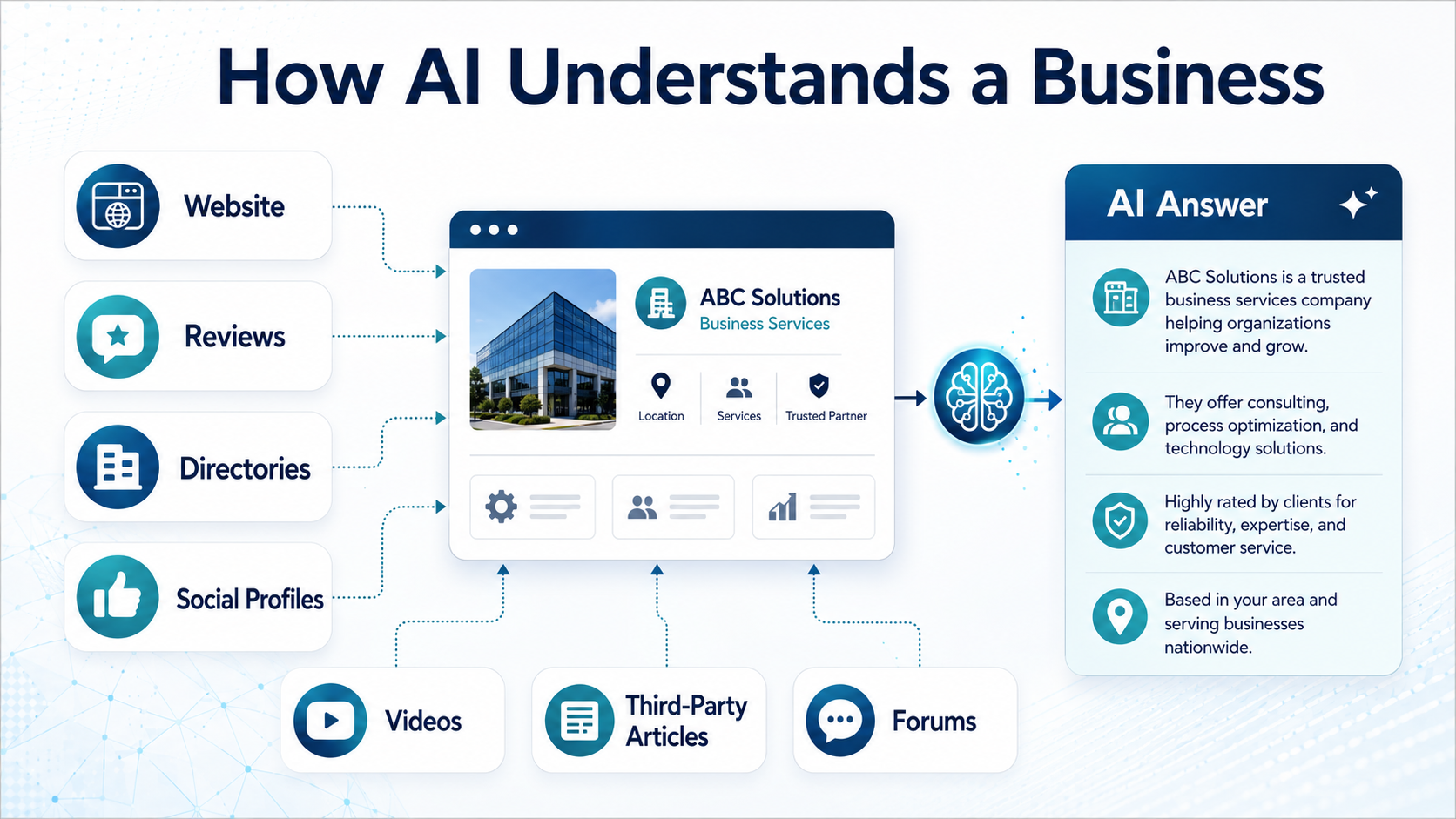
<p>AI tools do not rely only on your website. They draw signals from reviews, directories, social profiles, videos, third-party articles, forums, and older pages that may still be indexed.</p>
<p>That creates a practical challenge. Your website might describe your business clearly, but AI may find stronger or fresher signals somewhere else.</p>
<div id="attachment_7342" style="width: 1511px" class="wp-caption alignnone"><img wpfc-lazyload-disable="true" loading="lazy" decoding="async" aria-describedby="caption-attachment-7342" class=" wp-image-7342" src="https://www.wsiexpertosweb.com/wp-content/uploads/2026/05/ChatGPT-Image-28-may-2026-10_35_35-a.m.-1.png" alt="Diagram showing how AI understands a business through website content, reviews, directories, social media, and third-party sources" width="1501" height="845" srcset="https://www.wsiexpertosweb.com/wp-content/uploads/2026/05/ChatGPT-Image-28-may-2026-10_35_35-a.m.-1.png 1501w, https://www.wsiexpertosweb.com/wp-content/uploads/2026/05/ChatGPT-Image-28-may-2026-10_35_35-a.m.-1-1280x720.png 1280w, https://www.wsiexpertosweb.com/wp-content/uploads/2026/05/ChatGPT-Image-28-may-2026-10_35_35-a.m.-1-980x552.png 980w, https://www.wsiexpertosweb.com/wp-content/uploads/2026/05/ChatGPT-Image-28-may-2026-10_35_35-a.m.-1-480x270.png 480w" sizes="(min-width: 0px) and (max-width: 480px) 480px, (min-width: 481px) and (max-width: 980px) 980px, (min-width: 981px) and (max-width: 1280px) 1280px, (min-width: 1281px) 1501px, 100vw" /><p id="caption-attachment-7342" class="wp-caption-text">AI systems build a picture of your business using signals from many sources, not just your website.</p></div>
<h3>Third-party sources can shape the answer</h3>
<p>A directory listing, comparison article, YouTube description, review profile, or old company page can influence how your business appears in AI-generated answers.</p>
<p><a href="https://ahrefs.com/blog/ai-brand-visibility-correlations/">Ahrefs found that YouTube mentions had the strongest correlation with AI visibility</a> across ChatGPT, AI Mode, and AI Overviews. That does not mean every company needs a media studio. It does mean video signals can help AI understand what a brand does.</p>
<h3>Brand authority now matters more than content volume</h3>
<p>Publishing more content does not automatically build AI visibility. <a href="https://searchengineland.com/brand-authority-ai-search-476324">Search Engine Land argues that brand authority matters more than content volume in AI search</a>. That aligns with what many businesses now see in practice.</p>
<p>AI systems look for consistent, trusted signals. A brand that appears clearly across independent sources becomes easier to classify and recommend.</p>
<h3>Inconsistent signals create confident mistakes</h3>
<p>AI answers can sound confident even when they are wrong. That is the danger.</p>
<p>If your LinkedIn page says one thing, your website says another, and third-party listings describe an old service model, AI may combine those signals into an answer that does not reflect your business today.</p>
<p>That is why AI search optimization needs more than content updates. It needs brand accuracy across the places buyers and AI systems already check.</p>
<h2>What businesses should monitor</h2>
<p>This is where many organizations still use the wrong metrics.</p>
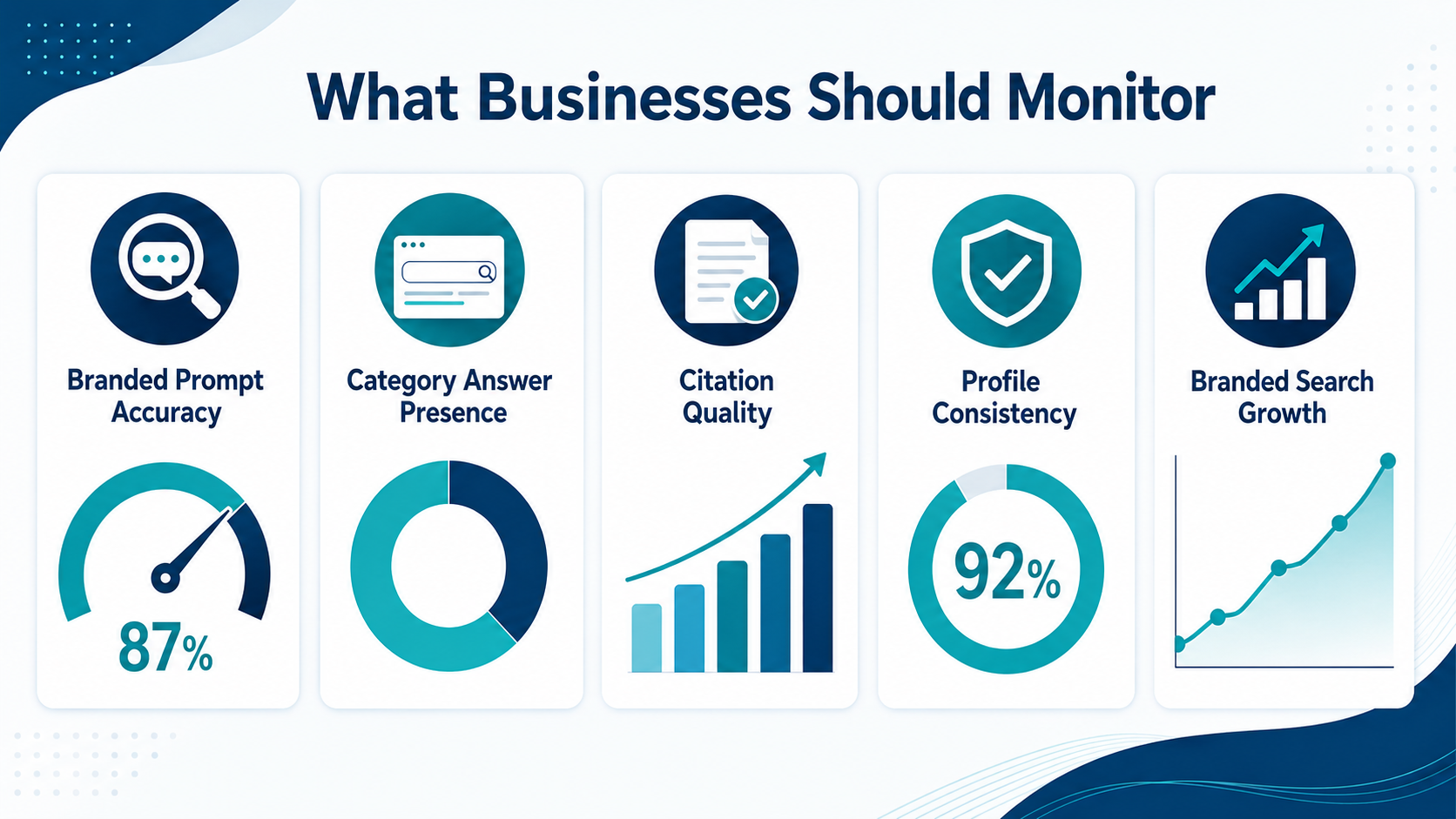
<p>They track rankings, sessions, and impressions. Those metrics still matter. But they do not fully show how AI represents the business before a buyer clicks.</p>
<div id="attachment_7343" style="width: 1490px" class="wp-caption alignnone"><img wpfc-lazyload-disable="true" loading="lazy" decoding="async" aria-describedby="caption-attachment-7343" class=" wp-image-7343" src="https://www.wsiexpertosweb.com/wp-content/uploads/2026/05/ChatGPT-Image-28-may-2026-10_35_35-a.m.-2.png" alt="Visual framework showing the metrics businesses should monitor for AI search visibility, including branded prompts, AI answers, citation quality, profile consistency, and branded search growth" width="1480" height="833" srcset="https://www.wsiexpertosweb.com/wp-content/uploads/2026/05/ChatGPT-Image-28-may-2026-10_35_35-a.m.-2.png 1480w, https://www.wsiexpertosweb.com/wp-content/uploads/2026/05/ChatGPT-Image-28-may-2026-10_35_35-a.m.-2-1280x720.png 1280w, https://www.wsiexpertosweb.com/wp-content/uploads/2026/05/ChatGPT-Image-28-may-2026-10_35_35-a.m.-2-980x552.png 980w, https://www.wsiexpertosweb.com/wp-content/uploads/2026/05/ChatGPT-Image-28-may-2026-10_35_35-a.m.-2-480x270.png 480w" sizes="(min-width: 0px) and (max-width: 480px) 480px, (min-width: 481px) and (max-width: 980px) 980px, (min-width: 981px) and (max-width: 1280px) 1280px, (min-width: 1281px) 1480px, 100vw" /><p id="caption-attachment-7343" class="wp-caption-text">Traditional SEO metrics are no longer enough to understand how your business appears in AI search.</p></div>
<p>Useful signals include:</p>
<ul>
<li>Accuracy across branded prompts</li>
<li>Presence in AI answers for category searches</li>
<li>Third-party citation quality</li>
<li>Consistency across owned and external profiles</li>
<li>Branded search growth after AI exposure</li>
</ul>
<p><a href="https://developers.google.com/search/docs/appearance/ai-features">Google explains that pages must meet Search eligibility requirements to appear as supporting links in AI features</a>. That means technical SEO still matters, but it is now only part of the picture.</p>
<p>The broader issue is whether your business gives AI systems enough clear, credible, and current information to work from.</p>
<h2>Why this becomes a growth issue</h2>
<p>AI search optimization affects pipeline because buyers now arrive more informed. In some cases, they arrive with opinions already formed by AI-generated answers.</p>
<p>That changes the sales conversation. Your team may spend time correcting outdated information instead of moving the opportunity forward.</p>
<p>It also changes marketing accountability. A business can keep stable search impressions and still lose demand if AI-driven answers favor competitors or describe the business poorly.</p>
<p>That is why this work belongs inside a broader digital visibility strategy, not inside a narrow SEO checklist.</p>
<h2>How WSI helps businesses prepare for AI search</h2>
<p>At WSI Expertos Web, we approach AI search optimization as a visibility and accuracy challenge.</p>
<p>Our <a href="https://www.wsiexpertosweb.com/our-services/audit-and-diagnosis/">audit and diagnosis service</a> helps identify where your business appears, how AI and search environments describe it, and where gaps may affect buyer confidence.</p>
<p>Our <a href="https://www.wsiexpertosweb.com/our-services/adaptive-search-everywhere-optimization/">Adaptive Search Everywhere Optimization</a> work builds on that assessment. It strengthens content clarity, authority signals, third-party consistency, structured information, and the broader visibility footprint that AI systems use to understand a brand.</p>
<p>For organizations also evaluating how AI affects internal operations, our <a href="https://www.wsiexpertosweb.com/our-services/ai-consultants/">AI consulting work</a> connects digital visibility with broader AI readiness and business transformation.</p>
<p>The goal is not to chase every new AI trend. The goal is to make sure buyers find the right version of your business when they ask the questions that matter.</p>
<h2>Frequently Asked Questions</h2>
<h3>What is AI search optimization?</h3>
<p>AI search optimization is the process of helping AI-powered search experiences understand, trust, and accurately represent your business. It includes clear owned content, consistent third-party signals, structured information, and credible sources that AI tools can use when generating answers.</p>
<h3>Is AI search optimization different from SEO?</h3>
<p>Yes, but it does not replace SEO. Traditional SEO helps your website remain technically sound, indexable, and relevant. AI search optimization adds focus on how AI tools summarize, compare, cite, and describe your business across a wider set of sources.</p>
<h3>Why do branded prompts matter?</h3>
<p>Branded prompts are questions buyers ask AI tools about your business by name. These prompts often happen near the shortlist stage. If AI answers them inaccurately, your business can lose consideration before a buyer reaches your website.</p>
<h3>How can a business know what AI says about it?</h3>
<p>A business can start by testing consistent prompts across ChatGPT, Gemini, Perplexity, and Google AI Overviews. The more valuable step is tracing those answers back to the sources shaping them, then addressing the gaps that create inaccurate or incomplete descriptions.</p>
<h3>How does WSI support AI search optimization?</h3>
<p>WSI supports AI search optimization through visibility assessment, audit and diagnosis, <a href="https://www.wsiexpertosweb.com/our-services/adaptive-search-everywhere-optimization/">Adaptive Search Everywhere Optimization</a>, and AI consulting. This helps businesses understand how they appear across AI-driven search environments and build a strategy that improves accuracy, trust, and discoverability.</p>
<p>If you want to understand how AI-powered search is describing your business before buyers act on it, the WSI team can help you evaluate the gaps and define the next steps. <a href="https://www.wsiexpertosweb.com/contact/">Start the conversation here</a>.</p>
<p>The post <a href="https://www.wsiexpertosweb.com/blog/ai-search-optimization-buyer-questions-2026/">AI Search Optimization: Why Buyer Questions Now Define Visibility</a> appeared first on <a href="https://www.wsiexpertosweb.com">wsiexpertosweb</a>.</p>
]]></content>
		
			</entry>
		<entry>
		<author>
			<name>Expertos-Shield</name>
							<uri>https://www.wsiexpertosweb.com</uri>
						</author>

		<title type="html"><![CDATA[Zero-Click Search Strategy: How Businesses Build Trust and Get Chosen Before the Click]]></title>
		<link rel="alternate" type="text/html" href="https://www.wsiexpertosweb.com/blog/zero-click-search-strategy-businesses-2026/" />

		<id>https://www.wsiexpertosweb.com/?p=7335</id>
		<updated>2026-05-15T17:50:47Z</updated>
		<published>2026-05-15T17:50:47Z</published>
		<category scheme="https://www.wsiexpertosweb.com/" term="Blog" /><category scheme="https://www.wsiexpertosweb.com/" term="ai search" /><category scheme="https://www.wsiexpertosweb.com/" term="ASEO" /><category scheme="https://www.wsiexpertosweb.com/" term="brand trust" /><category scheme="https://www.wsiexpertosweb.com/" term="digital visibility" /><category scheme="https://www.wsiexpertosweb.com/" term="GEO" /><category scheme="https://www.wsiexpertosweb.com/" term="google ai overviews" /><category scheme="https://www.wsiexpertosweb.com/" term="zero-click search strategy" />
		<summary type="html"><![CDATA[<p>A zero-click search strategy has become one of the most important priorities for businesses in 2026. Not because clicks stopped mattering, but because the decision to contact a business now happens long before any click occurs. Buyers compare, evaluate, and choose on the search results page itself. The numbers make the case clearly. According to [&#8230;]</p>
<p>The post <a href="https://www.wsiexpertosweb.com/blog/zero-click-search-strategy-businesses-2026/">Zero-Click Search Strategy: How Businesses Build Trust and Get Chosen Before the Click</a> appeared first on <a href="https://www.wsiexpertosweb.com">wsiexpertosweb</a>.</p>
]]></summary>

					<content type="html" xml:base="https://www.wsiexpertosweb.com/blog/zero-click-search-strategy-businesses-2026/"><![CDATA[<p>A zero-click search strategy has become one of the most important priorities for businesses in 2026. Not because clicks stopped mattering, but because the decision to contact a business now happens long before any click occurs. Buyers compare, evaluate, and choose on the search results page itself.</p>
<p>The numbers make the case clearly. According to <a href="https://www.digitalapplied.com/blog/zero-click-search-statistics-2026-complete-data">Digital Applied&#8217;s 2026 complete zero-click data analysis</a>, nearly two thirds of all Google searches now end without a single click to any website. For searches that trigger AI Overviews, that figure reaches 83%. For every 1,000 Google searches in the US, only around 360 result in a visit to any website.</p>
<p>Businesses that only focus on driving clicks are now optimizing for a minority of search interactions. The majority of their potential buyers are already deciding who to contact without ever visiting a website.</p>
<h2>Why your zero-click search strategy determines who gets chosen</h2>
<p>The shift is not just statistical. It is behavioral. Buyers today use Google, ChatGPT, Perplexity, and Google Business Profiles to form a shortlist without visiting a single website.</p>
<p>They read AI-generated summaries. They check review scores. They scan knowledge panels. By the time they decide to click or call, most of the evaluation is already done. The businesses that show up clearly and credibly in those pre-click environments win the contact. Those that do not get passed over.</p>
<p>This creates a challenge that is easy to misdiagnose. Many businesses watch stable impressions in Google Search Console while experiencing declining inquiries. Traffic reports look fine. Conversion from that traffic does not. The gap sits in the zero-click environment where the decision happens, not on the website where the conversion gets tracked.</p>
<h3>The visibility paradox most businesses have not noticed</h3>
<p>Being visible in search results and being chosen are now two separate outcomes. A business can appear in the top three organic results and still lose the contact to a competitor who shows up more credibly in an AI-generated answer, has stronger reviews, or has a clearer Google Business Profile.</p>
<p>We covered the traffic mechanics of this shift in our post on <a href="https://www.wsiexpertosweb.com/blog/zero-click-search-what-happens-when-google-answers/">what happens when Google answers and nobody visits your site</a>, which explains how the click-through landscape has changed for different query types.</p>
<h2>What a zero-click search strategy actually needs to address</h2>
<p>A zero-click search strategy is not a single tactic. It is a set of decisions about how a business presents itself across every touchpoint where buyers evaluate options before clicking.</p>
<h3>Clarity and credibility in AI-generated answers</h3>
<p>AI platforms like ChatGPT and Perplexity now shape how buyers understand their options. When someone asks which companies offer a specific service, AI generates an answer from the sources it considers most credible. Businesses that appear in those answers gain awareness and trust before a buyer visits any website.</p>
<p>According to <a href="https://www.digitalapplied.com/blog/60-percent-searches-zero-click-crisis-2026-seo-strategy">Digital Applied&#8217;s 2026 zero-click SEO strategy analysis</a>, AI search visitors who do click convert at 23 times the rate of traditional search visitors. The traffic volume is smaller, but the intent quality is dramatically higher. Being cited in AI answers does not always produce a click, but it consistently builds the brand familiarity that drives direct searches and direct contact later.</p>
<h3>Review presence and third-party validation</h3>
<p>83% of consumers use Google to read reviews for local businesses before making contact. 74% check at least two review sites before deciding. Reviews are not supplementary signals. They are primary decision inputs in a zero-click search environment.</p>
<p>Businesses with strong, recent, and responded-to reviews consistently outperform those without them in the evaluation phase. This is true on Google Business Profiles, on category-specific review platforms, and in AI-generated answers where review data feeds directly into how businesses get described and recommended.</p>
<h3>Consistency across every platform where buyers look</h3>
<p>AI systems build trust in a brand by finding consistent signals across multiple independent sources. When your website, Google Business Profile, LinkedIn, review platforms, and third-party mentions all describe your expertise and positioning in the same way, AI systems classify your brand as a reliable source.</p>
<p>When those signals are inconsistent or incomplete, even strong content on your own website does not overcome the gap. AI treats inconsistency as uncertainty, and uncertain sources do not get recommended.</p>
<h2>The zero-click search strategy gap most businesses have not closed</h2>
<p>According to <a href="https://www.ekamoira.com/blog/zero-click-search-2026-seo">Ekamoira&#8217;s January 2026 zero-click search analysis</a>, AI Overviews have doubled in appearance rate in a matter of months. Queries that previously generated featured snippets with click-through opportunities now generate comprehensive AI answers that satisfy user intent entirely on the results page.</p>
<p>Most businesses are not measuring this shift correctly. They track sessions, clicks, and rankings. They do not track AI Overview impression share, citation frequency in AI answers, or branded search growth driven by zero-click exposure. That measurement gap means most organizations are flying blind on the fastest-growing search surface in their market.</p>
<p>A business can improve significantly in the zero-click search environment without seeing that improvement in traditional analytics. Conversely, a business can look stable in its traffic reports while steadily losing ground in the evaluation phase where buyers actually decide.</p>
<h3>Content structure is the lever most businesses underuse</h3>
<p>AI systems extract answers from the top of content first. 44% of all AI citations come from the first 30% of a page. Content that buries its main point after a lengthy introduction loses citation opportunities before the AI reaches the useful part.</p>
<p>Question-based headings, clear direct answers in the first paragraph, FAQ sections with schema markup, and content organized around what buyers actually ask all contribute meaningfully to whether a business appears in zero-click search environments. These are structural decisions, not writing style preferences.</p>
<p>We covered the full picture of what drives AI citation visibility in our posts on <a href="https://www.wsiexpertosweb.com/blog/brand-visibility-ai-search-chatgpt-perplexity/">brand visibility in AI search</a> and <a href="https://www.wsiexpertosweb.com/blog/authority-in-ai-search-trust-signals-visibility/">authority in AI search</a>, both of which address the specific signals that determine whether a brand gets cited or ignored.</p>
<h2>How WSI builds zero-click search strategies for businesses</h2>
<p>Building an effective zero-click search strategy starts with an honest picture of where a business currently stands across every touchpoint where buyers evaluate options.</p>
<p>Our <a href="https://www.wsiexpertosweb.com/our-services/audit-and-diagnosis/">audit and diagnosis service</a> maps that picture. It identifies where the business appears in AI-generated answers and review environments, where gaps exist between current visibility and what competitors present, and which specific signals are limiting how buyers perceive and choose the business in zero-click search environments.</p>
<p>Our <a href="https://www.wsiexpertosweb.com/our-services/adaptive-search-everywhere-optimization/">Adaptive Search Everywhere Optimization</a> work then builds the visibility, authority, and consistency that a zero-click search strategy requires. That includes content structure, third-party presence, review platform strategy, schema implementation, and the cross-platform consistency that AI systems use to classify a brand as credible and citable.</p>
<p>For businesses that also want to understand how AI affects their internal operations alongside their external visibility, our <a href="https://www.wsiexpertosweb.com/our-services/ai-consultants/">AI consulting work</a> connects both dimensions in a way that builds long-term competitive advantage.</p>
<h2>Frequently Asked Questions</h2>
<h3>What is a zero-click search strategy?</h3>
<p>A zero-click search strategy focuses on building brand visibility, credibility, and trust in the search environments where buyers evaluate options before clicking. It recognizes that most purchase decisions now happen on the search results page, through AI-generated answers, review summaries, and knowledge panels, rather than on a business website. The goal is to be seen and chosen at that pre-click moment.</p>
<h3>Does a zero-click search strategy replace traditional SEO?</h3>
<p>No. Traditional SEO foundations, site structure, quality content, and credible backlinks remain important because they feed directly into how AI systems evaluate and trust a source. A zero-click search strategy builds on top of those foundations by also addressing AI citation visibility, review platform presence, and cross-platform consistency that traditional SEO does not cover.</p>
<h3>How do I know if my business is losing ground in zero-click search environments?</h3>
<p>The clearest early signal is a gap between stable or growing impressions in Google Search Console and declining click-through rates or inquiries. If your business appears in search but generates fewer contacts over time, the evaluation is likely happening in a zero-click environment where your brand is being passed over. Searching for your category in ChatGPT and Perplexity and checking whether your brand appears is another direct diagnostic step.</p>
<h3>How long does it take to see results from a zero-click search strategy?</h3>
<p>Content structure improvements and schema markup can influence AI citation visibility within weeks. Building broader third-party authority through review platforms and earned media takes three to six months to produce consistent results. Sustained improvement across all zero-click touchpoints is a six to twelve month investment that compounds over time as brand recognition grows across AI search environments.</p>
<p><strong>If you want to understand where your business currently stands in the zero-click search environments where your buyers are deciding, the WSI team can help you evaluate your visibility and build a strategy that gets you chosen before the click. </strong><a href="https://www.wsiexpertosweb.com/contact/">Start the conversation here.</a></p>
<p>The post <a href="https://www.wsiexpertosweb.com/blog/zero-click-search-strategy-businesses-2026/">Zero-Click Search Strategy: How Businesses Build Trust and Get Chosen Before the Click</a> appeared first on <a href="https://www.wsiexpertosweb.com">wsiexpertosweb</a>.</p>
]]></content>
		
			</entry>
		<entry>
		<author>
			<name>Expertos-Shield</name>
							<uri>https://www.wsiexpertosweb.com</uri>
						</author>

		<title type="html"><![CDATA[Digital Marketing Investment: What Drives Measurable Growth and What Gets in the Way]]></title>
		<link rel="alternate" type="text/html" href="https://www.wsiexpertosweb.com/blog/digital-marketing-investment-what-to-expect/" />

		<id>https://www.wsiexpertosweb.com/?p=7309</id>
		<updated>2026-05-08T22:48:51Z</updated>
		<published>2026-05-08T22:48:51Z</published>
		<category scheme="https://www.wsiexpertosweb.com/" term="Blog" /><category scheme="https://www.wsiexpertosweb.com/" term="business growth" /><category scheme="https://www.wsiexpertosweb.com/" term="digital marketing investment" /><category scheme="https://www.wsiexpertosweb.com/" term="digital strategy" /><category scheme="https://www.wsiexpertosweb.com/" term="inbound marketing" /><category scheme="https://www.wsiexpertosweb.com/" term="marketing budget" /><category scheme="https://www.wsiexpertosweb.com/" term="marketing ROI" /><category scheme="https://www.wsiexpertosweb.com/" term="paid traffic" />
		<summary type="html"><![CDATA[<p>Every business owner eventually asks the same question about a digital marketing investment: what should I expect to get back, and when? It is the right question. And the honest answer is that performance depends far more on how marketing is structured than on how much is spent. The numbers confirm this. According to Revenue [&#8230;]</p>
<p>The post <a href="https://www.wsiexpertosweb.com/blog/digital-marketing-investment-what-to-expect/">Digital Marketing Investment: What Drives Measurable Growth and What Gets in the Way</a> appeared first on <a href="https://www.wsiexpertosweb.com">wsiexpertosweb</a>.</p>
]]></summary>

					<content type="html" xml:base="https://www.wsiexpertosweb.com/blog/digital-marketing-investment-what-to-expect/"><![CDATA[<p>Every business owner eventually asks the same question about a digital marketing investment: what should I expect to get back, and when? It is the right question. And the honest answer is that performance depends far more on how marketing is structured than on how much is spent.</p>
<p>The numbers confirm this. According to <a href="https://www.revenuememo.com/p/small-business-marketing-budget-statistics">Revenue Memo&#8217;s 2026 small business marketing analysis</a>, 73% of small and mid-sized businesses lack confidence in their marketing strategies. That uncertainty does not come from a lack of spending. It comes from investing without a clear structure, defined objectives, or a realistic picture of how performance actually develops over time.</p>
<p>This post is about what a well-structured digital marketing investment actually looks like, what outcomes are realistic, and where most organizations lose momentum before results arrive.</p>
<h2>A digital marketing investment is not a purchase. It is a system.</h2>
<p>The most common mistake businesses make is treating marketing like a transaction. Pay for ads, get leads. Hire an agency, get traffic. The reality is more nuanced.</p>
<p>Digital marketing produces compounding results when channels work together and campaigns are refined over time. It produces disappointing results when channels run in isolation, budgets get cut before data accumulates, or execution does not align with a broader revenue objective.</p>
<p>The U.S. Small Business Administration recommends that businesses with under five million dollars in revenue allocate 7 to 8% of gross revenue to marketing. That benchmark exists not as an arbitrary percentage but as a reflection of what it takes to run, measure, and optimize consistently across channels without running out of budget before results emerge.</p>
<h3>Why marketing treated as overhead underperforms</h3>
<p>When businesses treat their digital marketing investment as an overhead cost, they manage it like one. Budgets shrink at the first sign of difficulty. Vendors get selected on price. Execution becomes fragmented.</p>
<p>When marketing is managed as a revenue system, the questions change. Instead of asking how little can be spent, leadership asks what revenue impact is possible and what it will take to build a channel that scales. That shift in framing is what separates organizations that get compounding returns from those that cycle through agencies without ever seeing consistent growth.</p>
<h2>What the data says about digital marketing investment returns</h2>
<p>The ROI benchmarks for digital marketing vary significantly by channel and time horizon. Understanding both is critical before setting budget expectations.</p>
<p>According to <a href="https://www.sender.net/marketing-glossary/return-on-investment-roi/statistics/">Sender&#8217;s 2025-2026 marketing ROI benchmark report</a>, a 5:1 return is the accepted benchmark for a good digital marketing investment. A 10:1 return puts an organization in exceptional territory. Below 2:1, most channels are not covering their opportunity cost.</p>
<p>The time horizon caveat matters. SEO that returns 2:1 in year one and 15:1 by year three is a better investment than paid search at a stable 3:1, if the business can sustain the investment long enough to reach compounding returns. That is why budget continuity is as important as budget size.</p>
<h3>Channel ROI benchmarks worth knowing</h3>
<p>Different channels serve different functions in a marketing system. Their ROI profiles reflect that.</p>
<p>SEO delivers $22 for every $1 invested over a sustained period and leads all channels in long-term ROI for B2B, according to <a href="https://www.data-mania.com/blog/b2b-marketing-roi-benchmarks-2025/">Data-Mania&#8217;s B2B marketing ROI benchmarks for 2026</a>. Email marketing returns $36 to $45 for every $1 spent and consistently ranks as the highest ROI channel for small businesses. Paid search delivers $2 for every $1 on average, but a well-managed Google Ads account can return up to $8.</p>
<p>These numbers require context. Channel performance depends heavily on execution quality, audience fit, and how well the channel integrates with the rest of the marketing system. A poorly managed campaign in any channel will sit well below its benchmark potential.</p>
<h3>The first 90 days build infrastructure, not instant returns</h3>
<p>The first quarter of a digital marketing investment rarely produces its best numbers. This is not a sign that strategy is failing. It is a sign that the system is being built.</p>
<p>Tracking infrastructure needs to be in place. Baseline data needs to accumulate. Campaigns need enough impressions to produce statistically meaningful results. Creative and copy need testing before the best-performing variants emerge.</p>
<p>Organizations that pull investment at the first sign of slow early returns tend to restart from zero repeatedly, never reaching the compounding phase where digital marketing investment genuinely accelerates. The businesses that sustain commitment through the foundation phase are the ones that build channels that consistently outperform benchmarks.</p>
<h2>What separates a productive digital marketing investment from one that stalls</h2>
<p>The organizations that generate consistent returns from digital marketing share a set of structural habits. None of them are about spending more.</p>
<h3>Strategy precedes channel selection</h3>
<p>High-performing organizations define revenue objectives before selecting channels. They ask which customer segments they are targeting, what those segments need to hear before making a decision, and which channels reach them at the right moment in the buying process.</p>
<p>Organizations that start with channel selection instead of strategy tend to produce activity without direction. Ads run. Content gets published. Traffic arrives. But without a clear path from awareness to conversion, most of that activity produces noise rather than revenue.</p>
<h3>Measurement is built in, not added later</h3>
<p>47% of businesses cannot accurately measure multi-channel attribution, according to the Sender benchmarks. That gap is a significant competitive disadvantage. Businesses that invest in proper tracking, from UTM parameters to CRM integration to attribution modeling, allocate budget more efficiently and compound performance faster than those that optimize from incomplete data.</p>
<p>Measurement should not be an afterthought. It is one of the first infrastructure decisions a digital marketing investment requires. Without it, optimization is guesswork and budget allocation stays misaligned with what is actually working.</p>
<h3>AI visibility is now part of the digital marketing investment equation</h3>
<p>One factor that most traditional marketing benchmarks do not yet capture is the shift toward AI-driven discovery. 49% of B2B marketers report declining traditional search traffic due to AI-generated answers. AI referral traffic converts at 3.76% on average, roughly 216% higher than standard web traffic.</p>
<p>A digital marketing investment that does not account for visibility in ChatGPT, Perplexity, and Google AI Overviews is leaving a measurable portion of high-intent discovery unaddressed. Buyers research in AI tools before they ever visit a website. Organizations that appear in those answers enter the conversation earlier and with more credibility.</p>
<h2>How WSI helps businesses structure their digital marketing investment</h2>
<p>A digital marketing investment produces its best results when it starts with a clear picture of where the business stands today, what channels fit its specific audience and objectives, and how success will be measured from day one.</p>
<p>Our <a href="https://www.wsiexpertosweb.com/our-services/audit-and-diagnosis/">audit and diagnosis service</a> gives businesses that starting point. It maps current digital performance across channels, identifies where gaps exist between current results and growth objectives, and surfaces the specific areas where investment will produce the most measurable impact.</p>
<p>Our <a href="https://www.wsiexpertosweb.com/our-services/digital-strategy/">digital strategy work</a> then builds the structure that connects marketing activity to revenue outcomes. That includes defining the right audience segments, selecting channels based on where those segments make decisions, and setting a measurement framework that gives leadership visibility into performance at every stage.</p>
<p>For businesses ready to drive immediate lead flow alongside longer-term organic growth, our <a href="https://www.wsiexpertosweb.com/our-services/paid-traffic/">paid traffic services</a> and <a href="https://www.wsiexpertosweb.com/our-services/inbound/">inbound marketing work</a> operate as complementary parts of the same system, designed to produce qualified leads at every stage of the buying journey.</p>
<p>For organizations that also want to capture the AI search opportunity as part of their digital marketing investment, our <a href="https://www.wsiexpertosweb.com/our-services/adaptive-search-everywhere-optimization/">Adaptive Search Everywhere Optimization</a> builds the visibility across ChatGPT, Perplexity, and Google AI Overviews that traditional SEO alone does not address.</p>
<h2>Frequently Asked Questions</h2>
<h3>How much should a business invest in digital marketing?</h3>
<p>The U.S. Small Business Administration recommends 7 to 8% of gross revenue for businesses under five million dollars in annual revenue. B2B companies typically allocate 2 to 5% of revenue, while B2C businesses allocate 5 to 10% because they require more channels to reach diverse customer segments. The right number depends on growth objectives, competitive landscape, and how quickly the business needs results.</p>
<h3>When does a digital marketing investment start producing results?</h3>
<p>Paid channels like Google Ads can drive qualified traffic within days of launch. SEO and content marketing typically require three to six months before organic traffic begins growing meaningfully, with compounding returns developing over 12 to 24 months. Email marketing can produce results within weeks. The most effective approach combines channels at different stages of the timeline to maintain consistent lead flow while building longer-term assets.</p>
<h3>How do I know if my digital marketing investment is working?</h3>
<p>Clear measurement is the foundation. Track channel-level performance through cost per lead, conversion rate, and customer acquisition cost. Monitor revenue impact through pipeline influenced by marketing, close rates on marketing-sourced leads, and customer lifetime value by channel. Over time, compare these metrics against industry benchmarks and your own historical performance. Consistent improvement against both baselines is the clearest signal that marketing is working.</p>
<h3>What is the biggest mistake businesses make with their first digital marketing investment?</h3>
<p>Starting with channels before defining strategy. Businesses that select platforms before clarifying their audience, offer, and revenue objective tend to generate traffic that does not convert. The second most common mistake is pulling investment before the foundation phase completes, which prevents any channel from reaching the compounding phase where returns accelerate. Both mistakes reset progress and waste the budget that was already spent building toward results.</p>
<p><strong>If you want to understand what a well-structured digital marketing investment looks like for your specific business and what outcomes are realistic given your objectives and market, the WSI team can help you build a clear path forward. </strong><a href="https://www.wsiexpertosweb.com/contact/">Start the conversation here.</a></p>
<p>The post <a href="https://www.wsiexpertosweb.com/blog/digital-marketing-investment-what-to-expect/">Digital Marketing Investment: What Drives Measurable Growth and What Gets in the Way</a> appeared first on <a href="https://www.wsiexpertosweb.com">wsiexpertosweb</a>.</p>
]]></content>
		
			</entry>
		<entry>
		<author>
			<name>Expertos-Shield</name>
							<uri>https://www.wsiexpertosweb.com</uri>
						</author>

		<title type="html"><![CDATA[Optimize Content for AI Search: What the Data Actually Shows in 2026]]></title>
		<link rel="alternate" type="text/html" href="https://www.wsiexpertosweb.com/blog/optimize-content-for-ai-search-2026/" />

		<id>https://www.wsiexpertosweb.com/?p=7305</id>
		<updated>2026-05-04T23:13:04Z</updated>
		<published>2026-05-04T23:13:04Z</published>
		<category scheme="https://www.wsiexpertosweb.com/" term="Blog" /><category scheme="https://www.wsiexpertosweb.com/" term="AI Overviews" /><category scheme="https://www.wsiexpertosweb.com/" term="ai search" /><category scheme="https://www.wsiexpertosweb.com/" term="ChatGPT citations" /><category scheme="https://www.wsiexpertosweb.com/" term="content strategy" /><category scheme="https://www.wsiexpertosweb.com/" term="digital visibility" /><category scheme="https://www.wsiexpertosweb.com/" term="GEO" /><category scheme="https://www.wsiexpertosweb.com/" term="optimize content for AI search" />
		<summary type="html"><![CDATA[<p>Businesses that optimize content for AI search are gaining a measurable advantage. Those that do not are watching competitors appear in answers their buyers trust, before those buyers ever visit a website. The gap is real, and the data from 2025 and 2026 makes the stakes very clear. AI referral traffic grew 527% year over [&#8230;]</p>
<p>The post <a href="https://www.wsiexpertosweb.com/blog/optimize-content-for-ai-search-2026/">Optimize Content for AI Search: What the Data Actually Shows in 2026</a> appeared first on <a href="https://www.wsiexpertosweb.com">wsiexpertosweb</a>.</p>
]]></summary>

					<content type="html" xml:base="https://www.wsiexpertosweb.com/blog/optimize-content-for-ai-search-2026/"><![CDATA[<p><span style="font-weight: 400;">Businesses that optimize content for AI search are gaining a measurable advantage. Those that do not are watching competitors appear in answers their buyers trust, before those buyers ever visit a website. The gap is real, and the data from 2025 and 2026 makes the stakes very clear.</span></p>
<p><span style="font-weight: 400;">AI referral traffic grew 527% year over year as of August 2025, according to </span><a href="https://www.position.digital/blog/ai-seo-statistics/"><span style="font-weight: 400;">Search Engine Land data cited by Position Digital</span></a><span style="font-weight: 400;">. ChatGPT alone now drives 87.4% of all AI referral traffic across the web. Visitors from AI platforms spend 68% more time on websites than visitors from traditional organic search. They also convert at significantly higher rates.</span></p>
<p><span style="font-weight: 400;">The question is no longer whether AI search matters. It is whether your content gives AI systems enough to work with to surface your business when it counts.</span></p>
<h2><b>Why traditional SEO is no longer enough to optimize content for AI search</b></h2>
<p><span style="font-weight: 400;">Strong Google rankings and AI search visibility now follow different rules. A business can sit in position one for its most important keyword and still be invisible in ChatGPT, Perplexity, and Google AI Overviews.</span></p>
<p><span style="font-weight: 400;">According to </span><a href="https://www.omnibound.ai/blog/ai-search-statistics"><span style="font-weight: 400;">Omnibound&#8217;s analysis of 55+ AI search data points</span></a><span style="font-weight: 400;">, 94% of B2B buyers used generative AI tools during their purchase process in 2025. These buyers form opinions before they visit a website. They use AI to compare options, validate expertise, and narrow their shortlist. If your business does not appear in those answers, you miss that moment entirely.</span></p>
<p><span style="font-weight: 400;">The old model rewarded businesses that ranked. The new model rewards businesses that get cited. Those are different outcomes built on different signals.</span></p>
<h3><b>The citation gap most businesses have not measured yet</b></h3>
<p><span style="font-weight: 400;">ChatGPT only cites 50% of the pages it retrieves during a search. 28.3% of ChatGPT&#8217;s most cited pages have zero organic visibility in Google.</span></p>
<p><span style="font-weight: 400;">That second number is striking. A meaningful share of AI-cited content never ranks in traditional search at all. AI systems evaluate content independently of Google&#8217;s ranking signals. Businesses that only optimize for Google are optimizing for a narrower audience than they think.</span></p>
<h2><b>What AI systems actually look for when they optimize content citations</b></h2>
<p><span style="font-weight: 400;">The research on AI citation behavior is now detailed enough to draw clear patterns. These are the factors that consistently drive inclusion in AI-generated answers.</span></p>
<h3><b>Content structure and answer-first writing</b></h3>
<p><span style="font-weight: 400;">44% of all AI citations come from the first 30% of a page. AI systems extract answers from the top of content first. Articles that bury the main point after a long introduction lose citation opportunities before the AI ever reaches the useful part.</span></p>
<p><span style="font-weight: 400;">Pages structured into sections of 120 to 180 words earn 70% more citations than pages with very short or unstructured sections. Clear headings, concise paragraphs, and FAQ sections all help AI systems identify and extract what is most relevant.</span></p>
<h3><b>Content depth and the use of credible data</b></h3>
<p><span style="font-weight: 400;">Semantic completeness has a correlation coefficient of 0.87 with AI citation frequency. In plain terms: content that covers a topic thoroughly from multiple angles scores far higher than content that covers it shallowly.</span></p>
<p><span style="font-weight: 400;">Articles over 2,900 words are 59% more likely to be cited by ChatGPT than articles under 800 words. Content that includes statistics, citations, and quoted sources achieves 30 to 40% higher visibility in AI responses. Depth and evidence are not optional extras. They are selection criteria.</span></p>
<h3><b>Freshness matters more than most teams realize</b></h3>
<p><span style="font-weight: 400;">Pages updated within two months earn 28% more AI citations than older content. Ahrefs found that the average AI-cited page is nearly a full year newer than pages that appear only in traditional search results.</span></p>
<p><span style="font-weight: 400;">Freshness signals to AI systems that a source is actively maintained and reflects current information. Content that was excellent in 2023 but has not been reviewed since loses ground steadily against content that gets updated regularly.</span></p>
<h2><b>The off-site signals that help you optimize content for AI search</b></h2>
<p><span style="font-weight: 400;">Optimizing content for AI search is not only about what sits on your website. It is also about how your brand and expertise appear across the broader web.</span></p>
<p><span style="font-weight: 400;">According to </span><a href="https://www.superlines.io/articles/ai-search-statistics/"><span style="font-weight: 400;">Superlines&#8217; analysis of 60+ AI search statistics</span></a><span style="font-weight: 400;">, domain authority is the number one predictor of AI citations, with a SHAP value of 0.63. High-traffic sites earn three times more AI citations than low-traffic sites. The same research found that citation volumes can differ by 615x between AI platforms for the same brand, proving that no single platform strategy is sufficient.</span></p>
<h3><b>Third-party validation carries three times the weight of backlinks</b></h3>
<p><span style="font-weight: 400;">Brand mentions now carry three times more weight than backlinks for AI visibility. Businesses with profiles on review platforms like G2, Trustpilot, and Capterra are three times more likely to be cited by ChatGPT than those without such presence.</span></p>
<p><span style="font-weight: 400;">Domains with significant brand mentions on Quora and Reddit have roughly four times higher chances of being cited than those with minimal community presence. AI systems use these signals to triangulate whether a brand is genuinely recognized as authoritative across independent sources.</span></p>
<p><span style="font-weight: 400;">We explored the full picture of how trust signals work across AI platforms in our post on </span><a href="https://www.wsiexpertosweb.com/blog/authority-in-ai-search-trust-signals-visibility/"><span style="font-weight: 400;">authority in AI search</span></a><span style="font-weight: 400;">, which covers what actually determines whether a brand gets cited or ignored.</span></p>
<h2><b>What happens when businesses fail to optimize content for AI search</b></h2>
<p><span style="font-weight: 400;">Businesses that ignore AI search optimization face a specific kind of invisibility. Their content exists. It may even rank on Google. But it does not appear in the answers buyers trust at the moment they are forming opinions.</span></p>
<p><span style="font-weight: 400;">Zero-click rates reach 83% when AI Overviews appear in search results. That means 83 out of 100 people who see an AI-generated answer never click through to any website. The brand that appears in the answer shapes the buyer&#8217;s thinking. Brands that do not appear are absent from that conversation entirely.</span></p>
<p><span style="font-weight: 400;">The business consequence is quiet but significant. Proposals that never come in. Shortlists the company never made. Competitors who got to shape the buyer&#8217;s thinking first. The CRM does not track what never arrived.</span></p>
<p><span style="font-weight: 400;">We covered the traffic side of this problem in more depth in our posts on </span><a href="https://www.wsiexpertosweb.com/blog/zero-click-search-what-happens-when-google-answers/"><span style="font-weight: 400;">zero-click search</span></a><span style="font-weight: 400;"> and </span><a href="https://www.wsiexpertosweb.com/blog/brand-visibility-ai-search-chatgpt-perplexity/"><span style="font-weight: 400;">brand visibility in AI search</span></a><span style="font-weight: 400;">, both of which address what the shift means for businesses still measuring performance only through traditional analytics.</span></p>
<h2><b>How WSI helps businesses optimize content for AI search</b></h2>
<p><span style="font-weight: 400;">Optimizing content for AI search is not a one-time change. It is an ongoing strategy that requires understanding where your visibility currently stands, which signals are missing, and how to build authority across the platforms AI systems actually draw from.</span></p>
<p><span style="font-weight: 400;">Our </span><a href="https://www.wsiexpertosweb.com/our-services/audit-and-diagnosis/"><span style="font-weight: 400;">audit and diagnosis service</span></a><span style="font-weight: 400;"> gives organizations a clear starting point. It maps current AI visibility across ChatGPT, Perplexity, and Google AI Overviews, identifies where authority signals are weak, and surfaces the specific gaps blocking citation visibility in the most important query areas.</span></p>
<p><span style="font-weight: 400;">From there, our </span><a href="https://www.wsiexpertosweb.com/our-services/adaptive-search-everywhere-optimization/"><span style="font-weight: 400;">Adaptive Search Everywhere Optimization</span></a><span style="font-weight: 400;"> work builds the content structure, external presence, and platform consistency that AI systems use to select and trust sources. This includes content restructuring, off-site authority development, schema implementation, and a freshness strategy that keeps content competitive over time.</span></p>
<p><span style="font-weight: 400;">For organizations that also want to understand how AI fits into their broader business operations, our </span><a href="https://www.wsiexpertosweb.com/our-services/ai-consultants/"><span style="font-weight: 400;">AI consulting work</span></a><span style="font-weight: 400;"> connects external visibility strategy with internal capability development.</span></p>
<h2><b>Frequently Asked Questions</b></h2>
<h3><b>What does it mean to optimize content for AI search?</b></h3>
<p><span style="font-weight: 400;">Optimizing content for AI search means structuring and positioning your digital content so that AI platforms like ChatGPT, Perplexity, and Google AI Overviews select it as a credible source when generating answers. It includes content structure, answer-first writing, depth, freshness, schema markup, and building external authority signals across third-party platforms.</span></p>
<h3><b>Does optimizing content for AI search hurt traditional SEO?</b></h3>
<p><span style="font-weight: 400;">No. The two approaches are complementary. Strong technical SEO foundations, quality content, and credible backlinks all support AI search visibility as well as traditional rankings. The main addition is a broader focus on external authority signals, content freshness, and answer-oriented structure that traditional SEO alone does not address.</span></p>
<h3><b>How long does it take to see results from AI search optimization?</b></h3>
<p><span style="font-weight: 400;">Structural changes to content, such as adding answer-first introductions, FAQ sections, and schema markup, can influence citation visibility in weeks. Building broader third-party authority through earned media and review platforms takes three to six months to produce consistent results. A full AI search visibility strategy is a sustained investment, not a one-time fix.</span></p>
<h3><b>Which AI platforms should we prioritize when optimizing content?</b></h3>
<p><span style="font-weight: 400;">ChatGPT drives 87.4% of all AI referral traffic, making it the highest-priority platform for most businesses. Google AI Overviews reach two billion monthly users across 200 countries and deserve equal attention. Perplexity accounts for roughly 15% of AI referral traffic and is particularly important in research-heavy categories. Citation volumes differ significantly across platforms, which is why a multi-platform approach consistently outperforms single-platform optimization.</span></p>
<p><b>If you want to understand where your content currently stands in AI search environments and what it would take to build real citation visibility, the WSI team can help you evaluate your position and define a practical path forward. </b><a href="https://www.wsiexpertosweb.com/contact/"><span style="font-weight: 400;">Start the conversation here.</span></a></p>
<p>The post <a href="https://www.wsiexpertosweb.com/blog/optimize-content-for-ai-search-2026/">Optimize Content for AI Search: What the Data Actually Shows in 2026</a> appeared first on <a href="https://www.wsiexpertosweb.com">wsiexpertosweb</a>.</p>
]]></content>
		
			</entry>
		<entry>
		<author>
			<name>Expertos-Shield</name>
							<uri>https://www.wsiexpertosweb.com</uri>
						</author>

		<title type="html"><![CDATA[How SEO and Thought Leadership Work Together to Build Market Authority]]></title>
		<link rel="alternate" type="text/html" href="https://www.wsiexpertosweb.com/blog/seo-thought-leadership-market-authority/" />

		<id>https://www.wsiexpertosweb.com/?p=7301</id>
		<updated>2026-04-28T20:44:38Z</updated>
		<published>2026-04-28T20:44:38Z</published>
		<category scheme="https://www.wsiexpertosweb.com/" term="Blog" /><category scheme="https://www.wsiexpertosweb.com/" term="brand authority" /><category scheme="https://www.wsiexpertosweb.com/" term="content marketing strategy" /><category scheme="https://www.wsiexpertosweb.com/" term="digital marketing strategy" /><category scheme="https://www.wsiexpertosweb.com/" term="inbound marketing" /><category scheme="https://www.wsiexpertosweb.com/" term="market authority" /><category scheme="https://www.wsiexpertosweb.com/" term="search visibility" /><category scheme="https://www.wsiexpertosweb.com/" term="SEO strategy" /><category scheme="https://www.wsiexpertosweb.com/" term="thought leadership" />
		<summary type="html"><![CDATA[<p>SEO and thought leadership work together by combining visibility with credibility. SEO helps your content get discovered. Thought leadership builds trust once users find it. When both align, companies build stronger market authority and generate better business results. Most organizations treat them as separate efforts. That decision limits performance. What Is SEO and Thought Leadership [&#8230;]</p>
<p>The post <a href="https://www.wsiexpertosweb.com/blog/seo-thought-leadership-market-authority/">How SEO and Thought Leadership Work Together to Build Market Authority</a> appeared first on <a href="https://www.wsiexpertosweb.com">wsiexpertosweb</a>.</p>
]]></summary>

					<content type="html" xml:base="https://www.wsiexpertosweb.com/blog/seo-thought-leadership-market-authority/"><![CDATA[<p data-start="718" data-end="891">SEO and thought leadership work together by combining visibility with credibility. SEO helps your content get discovered. Thought leadership builds trust once users find it.</p>
<p data-start="893" data-end="989">When both align, companies build stronger market authority and generate better business results.</p>
<p data-start="991" data-end="1075">Most organizations treat them as separate efforts. That decision limits performance.</p>
<hr data-start="1077" data-end="1080" />
<h2 data-section-id="1i0z29r" data-start="1082" data-end="1131">What Is SEO and Thought Leadership in Practice</h2>
<p data-start="1133" data-end="1219">SEO focuses on visibility. It helps your content appear when users search for answers.</p>
<p data-start="1221" data-end="1326">Thought leadership focuses on credibility. It positions your company as a trusted voice in your industry.</p>
<p data-start="1328" data-end="1393">Individually, both create value. Together, they create authority.</p>
<p data-start="1395" data-end="1487">SEO drives visibility. Thought leadership builds trust. Authority comes from combining both.</p>
<hr data-start="1489" data-end="1492" />
<h2 data-section-id="l8orfc" data-start="1494" data-end="1542">Why SEO Alone Does Not Build Market Authority</h2>
<p data-start="1544" data-end="1627">SEO can increase traffic. It can improve rankings. But it does not guarantee trust.</p>
<p data-start="1629" data-end="1706">Many companies rank for keywords but fail to convert that traffic into leads.</p>
<p data-start="1708" data-end="1799">Users visit their site, skim the content, and leave. They do not see a clear point of view.</p>
<p data-start="1801" data-end="1988">Search engines now prioritize expertise and credibility. This shift is visible in how <a href="https://blog.google/products/search/">Google explains the evolution of search</a>:</p>
<p data-start="1990" data-end="2052">Without authority, visibility does not translate into results.</p>
<hr data-start="2054" data-end="2057" />
<h2 data-section-id="1c8vvyd" data-start="2059" data-end="2110">Why Thought Leadership Without SEO Limits Growth</h2>
<p data-start="2112" data-end="2181">Thought leadership builds credibility. It helps your brand stand out.</p>
<p data-start="2183" data-end="2231">But without SEO, that content has limited reach.</p>
<p data-start="2233" data-end="2350">Many companies publish strong insights that never get discovered. They rely on social distribution or direct traffic.</p>
<p data-start="2352" data-end="2381">That approach does not scale.</p>
<p data-start="2383" data-end="2449">Thought leadership needs visibility. SEO provides that visibility.</p>
<hr data-start="2451" data-end="2454" />
<h2 data-section-id="174p7ok" data-start="2456" data-end="2492">Where Most Companies Get It Wrong</h2>
<p data-start="2494" data-end="2545">The problem is not effort. It is lack of alignment.</p>
<p data-start="2547" data-end="2648">Teams often separate SEO and content strategy. One focuses on keywords. Another focuses on messaging.</p>
<p data-start="2650" data-end="2683">This creates two common outcomes:</p>
<ul data-start="2685" data-end="2787">
<li data-section-id="192uk7l" data-start="2685" data-end="2728">Content that ranks but does not convert</li>
<li data-section-id="14gxn5o" data-start="2729" data-end="2787">Content that builds credibility but does not get found</li>
</ul>
<p data-start="2789" data-end="2830">Neither produces strong business results.</p>
<hr data-start="2832" data-end="2835" />
<h2 data-section-id="1dra7fz" data-start="2837" data-end="2898">What Happens When SEO and Thought Leadership Work Together</h2>
<p data-start="2900" data-end="2962">When aligned, SEO and thought leadership reinforce each other.</p>
<p data-start="2964" data-end="3041">SEO brings qualified traffic. Thought leadership builds trust and engagement.</p>
<p data-start="3043" data-end="3077">This creates a compounding effect.</p>
<p data-start="3079" data-end="3203">Your content attracts the right audience. Your perspective builds credibility. Your brand becomes associated with expertise.</p>
<p data-start="3205" data-end="3382">For a deeper explanation of how visibility is evolving, see this:<br />
<a href="https://www.wsiexpertosweb.com/blog/zero-click-search-what-happens-when-google-answers/">https://www.wsiexpertosweb.com/blog/zero-click-search-what-happens-when-google-answers/</a></p>
<hr data-start="3384" data-end="3387" />
<h2 data-section-id="f9owol" data-start="3389" data-end="3431">How to Align SEO and Thought Leadership</h2>
<p data-start="3433" data-end="3474">Alignment requires a structured approach.</p>
<p data-start="3476" data-end="3604">Start by identifying the topics where your company has real expertise. Focus on areas where you can provide a clear perspective.</p>
<p data-start="3606" data-end="3703">Then connect those topics to search demand. Understand what your audience is already looking for.</p>
<p data-start="3705" data-end="3776">From there, create content that answers those questions with authority.</p>
<p data-start="3778" data-end="3816">This is where many companies struggle.</p>
<p data-start="3900" data-end="3978"><a href="https://www.wsiexpertosweb.com/our-services/digital-strategy/">A structured strategy connects visibility, credibility, and business outcomes.</a></p>
<hr data-start="3980" data-end="3983" />
<h2 data-section-id="5asr31" data-start="3985" data-end="4035">Why Market Authority Matters More Than Rankings</h2>
<p data-start="4037" data-end="4094">Ranking means you appear. Authority means you get chosen.</p>
<p data-start="4096" data-end="4171">Users compare options quickly. They trust brands that show clear expertise.</p>
<p data-start="4173" data-end="4276">Search is moving toward fewer clicks and more direct answers. This makes authority even more important.</p>
<p data-start="4278" data-end="4328">Content must do more than rank. It must stand out.</p>
<hr data-start="4330" data-end="4333" />
<h2 data-section-id="11f71sk" data-start="4335" data-end="4382">How We Help Companies Build Market Authority</h2>
<p data-start="4384" data-end="4463">At WSI, we help companies connect SEO and thought leadership into one strategy.</p>
<p data-start="4465" data-end="4567">We identify where authority can be built. Then we align content with search demand and business goals.</p>
<p data-start="4569" data-end="4641">From there, <a href="https://www.wsiexpertosweb.com/our-services/ai-consultants/">we develop a structured plan that supports long-term growth</a>.</p>
<p data-start="4712" data-end="4792">This approach helps companies move from scattered efforts to consistent results.</p>
<hr data-start="4794" data-end="4797" />
<h2 data-section-id="9jfqz8" data-start="4799" data-end="4815">Key Takeaways</h2>
<ul data-start="4817" data-end="4965">
<li data-section-id="1ylmfuo" data-start="4817" data-end="4845">SEO increases visibility</li>
<li data-section-id="nzjud9" data-start="4846" data-end="4881">Thought leadership builds trust</li>
<li data-section-id="1wjbe21" data-start="4882" data-end="4928">Market authority comes from combining both</li>
<li data-section-id="1kn6hu9" data-start="4929" data-end="4965">Alignment determines performance</li>
</ul>
<p data-start="4967" data-end="5065">Companies that treat SEO and thought leadership as one system outperform those that separate them.</p>
<hr data-start="5067" data-end="5070" />
<h2 data-section-id="1r8frcv" data-start="5072" data-end="5101">Frequently Asked Questions</h2>
<h3 data-section-id="ug2j43" data-start="5103" data-end="5143">Does thought leadership improve SEO?</h3>
<p data-start="5145" data-end="5276">Yes. Thought leadership improves SEO when it aligns with search intent. It adds credibility to content that already has visibility.</p>
<hr data-start="5278" data-end="5281" />
<h3 data-section-id="riingb" data-start="5283" data-end="5345">What is the difference between SEO and thought leadership?</h3>
<p data-start="5347" data-end="5472">SEO focuses on getting found. Thought leadership focuses on being trusted. Together, they connect discovery with credibility.</p>
<hr data-start="5474" data-end="5477" />
<h3 data-section-id="k1uyqe" data-start="5479" data-end="5529">How do you combine SEO and thought leadership?</h3>
<p data-start="5531" data-end="5658">You combine them by aligning content topics with search demand and adding a clear point of view. Structure ensures consistency.</p>
<hr data-start="5660" data-end="5663" />
<h3 data-section-id="sf9im4" data-start="5665" data-end="5707">Why does content rank but not convert?</h3>
<p data-start="5709" data-end="5841">Content often lacks authority signals. It answers questions but does not build trust. Without credibility, users do not take action.</p>
<h3 data-section-id="alime6" data-start="362" data-end="425">Ready to Turn SEO and Thought Leadership Into Real Results?</h3>
<p data-start="427" data-end="475">Most companies already invest in SEO or content.</p>
<p data-start="477" data-end="547">Very few connect both into a system that builds real market authority.</p>
<p data-start="549" data-end="590">That is usually where performance stalls.</p>
<p data-start="592" data-end="749">If your content is generating traffic but not leads, or if your insights are not reaching the right audience, the issue is often not effort. It is structure.</p>
<p data-start="751" data-end="917">At WSI, we help companies align SEO and thought leadership into a strategy that connects visibility with credibility and turns both into measurable business outcomes.</p>
<p data-start="1026" data-end="1140">if you want to understand where your current efforts stand, the best starting point is a focused conversation.</p>
<p data-start="1142" data-end="1216">👉 Start the conversation here: <a href="https://www.wsiexpertosweb.com/contact/">https://www.wsiexpertosweb.com/contact/</a></p>
<p>The post <a href="https://www.wsiexpertosweb.com/blog/seo-thought-leadership-market-authority/">How SEO and Thought Leadership Work Together to Build Market Authority</a> appeared first on <a href="https://www.wsiexpertosweb.com">wsiexpertosweb</a>.</p>
]]></content>
		
			</entry>
		<entry>
		<author>
			<name>Expertos-Shield</name>
							<uri>https://www.wsiexpertosweb.com</uri>
						</author>

		<title type="html"><![CDATA[ChatGPT Ads Manager: What It Means for Your Advertising Strategy]]></title>
		<link rel="alternate" type="text/html" href="https://www.wsiexpertosweb.com/blog/chatgpt-ads-manager-advertising-strategy/" />

		<id>https://www.wsiexpertosweb.com/?p=7297</id>
		<updated>2026-04-25T00:24:47Z</updated>
		<published>2026-04-25T00:24:47Z</published>
		<category scheme="https://www.wsiexpertosweb.com/" term="Blog" /><category scheme="https://www.wsiexpertosweb.com/" term="ai adoption" /><category scheme="https://www.wsiexpertosweb.com/" term="AI advertising" /><category scheme="https://www.wsiexpertosweb.com/" term="AI in marketing" /><category scheme="https://www.wsiexpertosweb.com/" term="AI marketing tools" /><category scheme="https://www.wsiexpertosweb.com/" term="ChatGPT Ads Manager" /><category scheme="https://www.wsiexpertosweb.com/" term="conversational AI" /><category scheme="https://www.wsiexpertosweb.com/" term="digital advertising strategy" /><category scheme="https://www.wsiexpertosweb.com/" term="future of advertising" /><category scheme="https://www.wsiexpertosweb.com/" term="marketing strategy" /><category scheme="https://www.wsiexpertosweb.com/" term="paid media strategy" />
		<summary type="html"><![CDATA[<p>The conversation around ChatGPT Ads Manager is growing fast. Many business leaders are asking the same question: how will advertising change if AI platforms start managing campaigns directly? The short answer is that the rules are shifting. But the bigger issue is not the tool itself. It is how organizations adapt their strategy to a [&#8230;]</p>
<p>The post <a href="https://www.wsiexpertosweb.com/blog/chatgpt-ads-manager-advertising-strategy/">ChatGPT Ads Manager: What It Means for Your Advertising Strategy</a> appeared first on <a href="https://www.wsiexpertosweb.com">wsiexpertosweb</a>.</p>
]]></summary>

					<content type="html" xml:base="https://www.wsiexpertosweb.com/blog/chatgpt-ads-manager-advertising-strategy/"><![CDATA[<p data-start="814" data-end="1009"><a href="https://help.openai.com/en/articles/20001047-ads-in-chatgpt">The conversation around <strong data-start="838" data-end="861">ChatGPT Ads Manager</strong> is growing fast</a>. Many business leaders are asking the same question: how will advertising change if AI platforms start managing campaigns directly?</p>
<p data-start="1011" data-end="1232">The short answer is that the rules are shifting. But the bigger issue is not the tool itself. It is how organizations adapt their strategy to a new environment where AI influences how users discover products and services.</p>
<p data-start="1234" data-end="1340">Most companies are still thinking in terms of traditional paid media. That mindset will not hold for long.</p>
<hr data-start="1342" data-end="1345" />
<h2 data-section-id="1k89iit" data-start="1347" data-end="1391">Why ChatGPT Ads Manager matters right now</h2>
<p data-start="1393" data-end="1616">Platforms like <span class="hover:entity-accent entity-underline inline cursor-pointer align-baseline"><span class="whitespace-normal">OpenAI</span></span> and <span class="hover:entity-accent entity-underline inline cursor-pointer align-baseline"><span class="whitespace-normal">Google</span></span> are redefining how users interact with information. Instead of clicking through multiple links, users now expect direct answers.</p>
<p data-start="1618" data-end="1686">That shift creates a new layer between your brand and your audience.</p>
<p data-start="1688" data-end="1901">If AI tools begin to manage or influence advertising placement, targeting, and messaging, then your visibility will depend on more than budget. It will depend on how well your brand is understood by these systems.</p>
<p data-start="1903" data-end="1953">This is where most organizations are not prepared.</p>
<hr data-start="1955" data-end="1958" />
<h2 data-section-id="bghans" data-start="1960" data-end="2011">The gap between AI tools and advertising results</h2>
<p data-start="2013" data-end="2138"><a href="https://www.mckinsey.com/capabilities/quantumblack/our-insights/the-state-of-ai">Many teams assume that new AI-driven tools will automatically improve campaign performance</a>. In practice, that rarely happens.</p>
<p data-start="2140" data-end="2206">The problem is not access to technology. The problem is structure.</p>
<p data-start="2208" data-end="2387">Teams launch campaigns faster than ever. They test more variations. They collect more data. But performance often stays flat because there is no clear framework guiding decisions.</p>
<p data-start="2389" data-end="2491">Without that structure, even a tool like ChatGPT Ads Manager becomes just another layer of complexity.</p>
<hr data-start="2493" data-end="2496" />
<h2 data-section-id="a6azal" data-start="2498" data-end="2552">What changes when AI influences campaign management</h2>
<p data-start="2554" data-end="2633">AI-driven advertising environments change three core elements of your strategy.</p>
<h3 data-section-id="z6i27f" data-start="2635" data-end="2689">1. Targeting becomes interpretation, not selection</h3>
<p data-start="2691" data-end="2781">Traditional platforms rely on audience targeting. AI systems rely on understanding intent.</p>
<p data-start="2783" data-end="2959">That means your messaging, content, and positioning must be clear enough for AI to interpret correctly. If your brand is not well defined, your visibility becomes inconsistent.</p>
<h3 data-section-id="1140tyo" data-start="2961" data-end="3011">2. Optimization shifts from manual to systemic</h3>
<p data-start="3013" data-end="3161">Campaign optimization will not rely only on bid adjustments or A/B testing. It will depend on how well your entire marketing ecosystem is connected.</p>
<p data-start="3163" data-end="3252">This includes your content, your website, your data structure, and your conversion paths, <a href="https://www.wsiexpertosweb.com/our-services/digital-strategy/">all of which need to be aligned under a clear digital marketing strategy</a>.</p>
<p data-start="3254" data-end="3322">If those elements are disconnected, no AI tool will fix the outcome.</p>
<h3 data-section-id="1jf657x" data-start="3324" data-end="3370">3. Visibility depends on authority signals</h3>
<p data-start="3372" data-end="3495">AI platforms prioritize trusted sources. <a href="https://arxiv.org/abs/2603.29071">That includes brand authority, content relevance, and consistency across channels.</a></p>
<p data-start="3497" data-end="3598">If your digital presence is fragmented, your campaigns will struggle to perform regardless of budget.</p>
<hr data-start="3600" data-end="3603" />
<h2 data-section-id="18s74ps" data-start="3605" data-end="3638">Where most companies get stuck</h2>
<p data-start="3640" data-end="3684">The pattern is consistent across industries.</p>
<ul data-start="3686" data-end="3936">
<li data-section-id="1ha8o48" data-start="3686" data-end="3758">Teams experiment with new AI tools without redefining their strategy</li>
<li data-section-id="1x7gycn" data-start="3759" data-end="3817">Campaigns scale before performance is fully understood</li>
<li data-section-id="1e66die" data-start="3818" data-end="3878">Data exists, but no one connects it to business outcomes</li>
<li data-section-id="skoqph" data-start="3879" data-end="3936">Leadership expects results without changing processes</li>
</ul>
<p data-start="3938" data-end="4004">This creates the illusion of progress while performance stagnates.</p>
<p data-start="4006" data-end="4102">The introduction of ChatGPT Ads Manager will not solve these issues. It will expose them faster.</p>
<hr data-start="4104" data-end="4107" />
<h2 data-section-id="1i0y45s" data-start="4109" data-end="4161">How to approach ChatGPT Ads Manager strategically</h2>
<p data-start="4163" data-end="4225">The opportunity is real, but it requires a different approach.</p>
<h3 data-section-id="zig6r0" data-start="4227" data-end="4272">Start with business objectives, not tools</h3>
<p data-start="4274" data-end="4429">Before adopting any AI-driven advertising platform, <a href="https://www.wsiexpertosweb.com/our-services/ai-consultants/">define what success looks like</a>. That includes measurable outcomes tied to revenue, not just engagement.</p>
<h3 data-section-id="fbkk8f" data-start="4431" data-end="4464">Align your data and messaging</h3>
<p data-start="4466" data-end="4582">AI systems rely on consistent signals. Your campaigns, website, and content must communicate the same value clearly.</p>
<h3 data-section-id="1qiisbr" data-start="4584" data-end="4613">Build internal capability</h3>
<p data-start="4615" data-end="4718">Tools do not create results on their own. <a href="https://www.wsiexpertosweb.com/our-services/ai-business-training/">Teams need to understand how to apply them in real workflows.</a></p>
<p data-start="4720" data-end="4823">This is where many organizations fall behind. They invest in platforms but do not invest in capability.</p>
<hr data-start="4825" data-end="4828" />
<h2 data-section-id="1bakvye" data-start="4830" data-end="4878">Why execution becomes the real differentiator</h2>
<p data-start="4880" data-end="4997">As AI tools become more accessible, the gap between companies will not come from access. It will come from execution.</p>
<p data-start="4999" data-end="5116">Organizations that build structured processes, train their teams, and align their strategy will extract value faster.</p>
<p data-start="5118" data-end="5188">Those that rely only on tools will struggle to see measurable returns.</p>
<p data-start="5190" data-end="5250">This is exactly where structured support makes a difference.</p>
<p data-start="5252" data-end="5446">If you are evaluating how AI-driven platforms will impact your advertising, the starting point is not the tool. It is understanding how your current strategy performs under these new conditions.</p>
<hr data-start="5448" data-end="5451" />
<h2 data-section-id="1r8frcv" data-start="5453" data-end="5482">Frequently Asked Questions</h2>
<h3 data-section-id="4dnze9" data-start="5484" data-end="5516">What is ChatGPT Ads Manager?</h3>
<p data-start="5518" data-end="5705">ChatGPT Ads Manager refers to the potential use of AI platforms like ChatGPT to support or automate campaign planning, targeting, and optimization within digital advertising environments.</p>
<h3 data-section-id="38ifc1" data-start="5707" data-end="5769">Will ChatGPT Ads Manager replace traditional ad platforms?</h3>
<p data-start="5771" data-end="5925">No. It is more likely to complement existing platforms rather than replace them entirely. However, it will change how campaigns are planned and optimized.</p>
<h3 data-section-id="16ed0vp" data-start="5927" data-end="5973">Do companies need to adopt it immediately?</h3>
<p data-start="5975" data-end="6117">Not necessarily. What matters is preparing your strategy for AI-driven environments. That preparation has a bigger impact than early adoption.</p>
<h3 data-section-id="1u0jcf5" data-start="6119" data-end="6171">What is the biggest risk of ignoring this trend?</h3>
<p data-start="6173" data-end="6340">The biggest risk is losing visibility. As AI platforms influence how users discover brands, companies without a structured approach may struggle to remain competitive.</p>
<p>The post <a href="https://www.wsiexpertosweb.com/blog/chatgpt-ads-manager-advertising-strategy/">ChatGPT Ads Manager: What It Means for Your Advertising Strategy</a> appeared first on <a href="https://www.wsiexpertosweb.com">wsiexpertosweb</a>.</p>
]]></content>
		
			</entry>
		<entry>
		<author>
			<name>Expertos-Shield</name>
							<uri>https://www.wsiexpertosweb.com</uri>
						</author>

		<title type="html"><![CDATA[Landing Pages for Lead Generation: Why Most Campaigns Lose Conversions Before They Start]]></title>
		<link rel="alternate" type="text/html" href="https://www.wsiexpertosweb.com/blog/landing-pages-for-lead-generation-what-works/" />

		<id>https://www.wsiexpertosweb.com/?p=7284</id>
		<updated>2026-04-24T18:26:26Z</updated>
		<published>2026-04-20T18:27:52Z</published>
		<category scheme="https://www.wsiexpertosweb.com/" term="Blog" /><category scheme="https://www.wsiexpertosweb.com/" term="conversion rate optimization" /><category scheme="https://www.wsiexpertosweb.com/" term="digital strategy" /><category scheme="https://www.wsiexpertosweb.com/" term="inbound marketing" /><category scheme="https://www.wsiexpertosweb.com/" term="landing pages" /><category scheme="https://www.wsiexpertosweb.com/" term="lead generation" /><category scheme="https://www.wsiexpertosweb.com/" term="paid traffic" />
		<summary type="html"><![CDATA[<p>Landing pages for lead generation are among the highest-leverage assets in digital marketing. Companies spend significant budgets on paid traffic, SEO, and email campaigns to drive visitors to these pages. Yet most of that investment underperforms because the page itself was never built to convert. According to Backlinko&#8217;s analysis of landing page statistics, the average [&#8230;]</p>
<p>The post <a href="https://www.wsiexpertosweb.com/blog/landing-pages-for-lead-generation-what-works/">Landing Pages for Lead Generation: Why Most Campaigns Lose Conversions Before They Start</a> appeared first on <a href="https://www.wsiexpertosweb.com">wsiexpertosweb</a>.</p>
]]></summary>

					<content type="html" xml:base="https://www.wsiexpertosweb.com/blog/landing-pages-for-lead-generation-what-works/"><![CDATA[<p>Landing pages for lead generation are among the highest-leverage assets in digital marketing. Companies spend significant budgets on paid traffic, SEO, and email campaigns to drive visitors to these pages. Yet most of that investment underperforms because the page itself was never built to convert.</p>
<p>According to <a href="https://backlinko.com/landing-page-stats">Backlinko&#8217;s analysis of landing page statistics</a>, the average landing page conversion rate across all industries sits at 10.76%. The gap between the average and the bottom is significant. Nearly half of all landing page visitors exit without taking any action at all.</p>
<p>That gap is not a traffic problem. It is a page problem. And it is one most organizations do not address because they focus all their attention on getting clicks, not on what happens after the click arrives.</p>
<h2>Why landing pages for lead generation outperform homepages</h2>
<p>Many businesses send paid traffic to their homepage. That is one of the most common and costly mistakes in digital marketing.</p>
<p>One homepage serves many purposes at once. It introduces the company. It presents a range of services. It invites visitors to explore. That versatility is exactly what makes it a poor destination for campaign traffic. A visitor who arrives from a paid ad with one specific intent faces a page that offers a dozen directions. Most of them leave.</p>
<p>A dedicated landing page for lead generation does one thing. It matches the specific promise in the ad or email that brought the visitor there, presents a single clear offer, and removes every element that could distract from that action. That focus is what drives conversion.</p>
<h3>Multiple offers on one page destroy conversions</h3>
<p>Research from <a href="https://www.hostinger.com/tutorials/landing-page-statistics">Hostinger&#8217;s 2026 landing page data</a> confirms this clearly: having multiple offers on a single landing page decreases conversion rates by 266%. One offer, one page, one action is not a simplification. It is a strategy.</p>
<p>The same research shows that companies with 10 to 15 landing pages generate 55% more leads than those with fewer than 10. That is not because more pages means more traffic. It is because more targeted pages means more relevance, and relevance is what converts.</p>
<h2>What high-converting lead generation landing pages actually have in common</h2>
<p>The data on landing page performance is consistent across sources. High-converting pages share a set of characteristics that lower-performing pages consistently lack.</p>
<h3>Message match between ad and landing page</h3>
<p>When the headline and messaging on a landing page mirror the ad or link that brought the visitor there, trust increases immediately. Mismatched expectations cause visitors to bounce within seconds. A visitor who clicks an ad about a specific service and arrives at a generic page about the company has no reason to stay.</p>
<p>Message match is one of the most impactful factors in lead generation landing page performance. It also requires planning before the page is built, not as an afterthought once the campaign is running.</p>
<h3>Page speed determines whether visitors ever see the offer</h3>
<p>According to <a href="https://genesysgrowth.com/blog/landing-page-conversion-stats-for-marketing-leaders">Genesys Growth&#8217;s analysis of 40 landing page statistics</a>, pages that load in one second convert at three times the rate of pages that take five seconds to load. A one-second delay alone can cause a 7% drop in conversions.</p>
<p>Mobile now accounts for 82.9% of landing page traffic. A page that loads slowly or renders poorly on a phone loses the majority of its potential leads before they ever read the headline.</p>
<h3>Social proof and trust signals reduce hesitation</h3>
<p>92% of consumers read testimonials when evaluating a purchase or inquiry. Testimonials, client logos, and case study references on landing pages reduce the friction that stops visitors from submitting their contact information.</p>
<p>Top-performing lead generation landing pages feature social proof prominently. They do not hide it in a footer. They place it where a visitor who is deciding whether to act will naturally look.</p>
<h2>The conversion gap in landing pages for lead generation</h2>
<p>Most organizations know their landing pages could perform better. The challenge is identifying where the problem actually lives.</p>
<p>Traffic source matters significantly. Email traffic converts at roughly 19.3% on average, while organic search traffic converts at 2.7%. Comparing a page&#8217;s performance without accounting for traffic source produces misleading conclusions. A page may look weak simply because it receives cold social traffic, not because the page itself is the problem.</p>
<p>Copy readability also drives significant performance differences. Pages written at a 5th to 7th grade reading level convert at 11.1% on average. Pages with complex professional copy convert at 5.3%. Simpler language is not less persuasive. It is more accessible, and accessibility converts.</p>
<h3>Form length has a direct impact on lead generation landing page results</h3>
<p>Shorter forms generate more submissions. Cutting form fields from four to three can increase conversions by up to 50%. Single-field forms that ask only for an email address convert at 23.4% on average, nearly three times the rate of four-field forms.</p>
<p>The instinct to collect more information at the first touchpoint works against lead generation. The goal of a landing page is to start a conversation, not complete a qualification process. Additional information gets collected later, after trust is established.</p>
<h2>Testing is what separates good pages from great ones</h2>
<p>A well-built landing page is a starting point, not a finished product. The pages that consistently sit in the top 10% of conversion performance share one characteristic: they get tested systematically.</p>
<p>A/B testing allows organizations to isolate individual elements, headlines, CTA copy, image choices, form length, and measure the impact of each change with real traffic. Only 1 in 8 A/B tests produces a statistically significant improvement, which is why sustained testing across multiple cycles produces results that one-time changes rarely achieve.</p>
<p>Personalized CTAs convert 42% more visitors than generic ones. That improvement does not come from a single creative decision. It comes from understanding audience segments well enough to speak to each one specifically, which requires both the right data and the capacity to act on it.</p>
<h2>How WSI builds landing pages for lead generation that perform</h2>
<p>A high-converting lead generation landing page does not start with design. It starts with strategy: a clear picture of who the audience is, what offer will resonate with them, what action the page is designed to drive, and how success will be measured.</p>
<p>Our <a href="https://www.wsiexpertosweb.com/our-services/digital-strategy/">digital strategy work</a> builds the foundation that makes landing pages effective. Understanding the target audience, defining the brand narrative, and mapping the right offer to the right segment are all decisions that happen before a page gets built.</p>
<p>For organizations running paid campaigns, our <a href="https://www.wsiexpertosweb.com/our-services/paid-traffic/">paid traffic services</a> connect campaign design to landing page strategy from the start. Message match between ad and page is built in, not added after launch. That connection between what the ad promises and what the page delivers is what keeps paid traffic from becoming wasted spend.</p>
<p>Now, for organizations building organic lead generation through content, our <a href="https://www.wsiexpertosweb.com/our-services/inbound/">inbound marketing services</a> integrate landing pages into a broader strategy that attracts the right visitors and converts them at each stage of the buying journey.</p>
<p>Organizations that want to understand how their current pages are performing before building new ones benefit from our <a href="https://www.wsiexpertosweb.com/our-services/audit-and-diagnosis/">audit and diagnosis service</a>. It surfaces the specific gaps in conversion performance and gives leadership the information needed to prioritize improvements that will produce the most impact.</p>
<h2>Frequently Asked Questions</h2>
<h3>What is a landing page for lead generation?</h3>
<p>A lead generation landing page is a standalone web page built around a single offer and a single action. Unlike a homepage, which presents multiple services and invites exploration, a landing page focuses all attention on converting the visitor into a lead, typically by capturing contact information in exchange for something of value.</p>
<h3>What is a good conversion rate for a lead generation landing page?</h3>
<p>The median conversion rate across all industries is approximately 6.6%, based on Unbounce&#8217;s Q4 2024 analysis of 41,000 landing pages. A rate of 10% or above generally indicates strong performance. Top performers exceed 15% in specific scenarios such as webinar registrations and warm email traffic. The right benchmark depends on industry, traffic source, and the nature of the offer.</p>
<h3>How many landing pages does a business need?</h3>
<p>More than most organizations currently have. Companies with 10 to 15 landing pages generate 55% more leads than those with fewer than 10, because more targeted pages mean more relevance for different audience segments. There is no ideal number. The right number is determined by how many distinct audience segments and campaign offers a business runs.</p>
<h3>Why do visitors leave a landing page without converting?</h3>
<p>The most common reasons are slow loading speed, mismatched messaging between the ad and the page, too many competing elements or CTAs, a form that asks for too much information, and lack of social proof. Most of these issues are diagnosable through analytics and fixable through structured testing.</p>
<p><strong>If your landing pages are generating traffic but not the leads your business needs, the WSI team can help you identify where conversions are breaking down and build a stronger path from click to contact. </strong><a href="https://www.wsiexpertosweb.com/contact/">Start the conversation here.</a></p>
<p>The post <a href="https://www.wsiexpertosweb.com/blog/landing-pages-for-lead-generation-what-works/">Landing Pages for Lead Generation: Why Most Campaigns Lose Conversions Before They Start</a> appeared first on <a href="https://www.wsiexpertosweb.com">wsiexpertosweb</a>.</p>
]]></content>
		
			</entry>
		<entry>
		<author>
			<name>Expertos-Shield</name>
							<uri>https://www.wsiexpertosweb.com</uri>
						</author>

		<title type="html"><![CDATA[AI ROI for Business: Why Most Companies Are Investing More and Getting Less]]></title>
		<link rel="alternate" type="text/html" href="https://www.wsiexpertosweb.com/blog/ai-roi-for-business-why-most-companies-are-investing-more-and-getting-less/" />

		<id>https://www.wsiexpertosweb.com/?p=7280</id>
		<updated>2026-04-15T22:08:30Z</updated>
		<published>2026-04-15T22:08:30Z</published>
		<category scheme="https://www.wsiexpertosweb.com/" term="Blog" /><category scheme="https://www.wsiexpertosweb.com/" term="ai adoption" /><category scheme="https://www.wsiexpertosweb.com/" term="AI business training" /><category scheme="https://www.wsiexpertosweb.com/" term="ai consulting" /><category scheme="https://www.wsiexpertosweb.com/" term="ai implementation" /><category scheme="https://www.wsiexpertosweb.com/" term="AI ROI" /><category scheme="https://www.wsiexpertosweb.com/" term="ai strategy" /><category scheme="https://www.wsiexpertosweb.com/" term="digital transformation" />
		<summary type="html"><![CDATA[<p>AI ROI for business is the conversation that defines 2026. Companies are spending more on AI than ever before. Yet most of them cannot point to real financial results. That gap is now one of the most widely discussed topics in boardrooms, finance forums, and executive leadership communities around the world. A new study by [&#8230;]</p>
<p>The post <a href="https://www.wsiexpertosweb.com/blog/ai-roi-for-business-why-most-companies-are-investing-more-and-getting-less/">AI ROI for Business: Why Most Companies Are Investing More and Getting Less</a> appeared first on <a href="https://www.wsiexpertosweb.com">wsiexpertosweb</a>.</p>
]]></summary>

					<content type="html" xml:base="https://www.wsiexpertosweb.com/blog/ai-roi-for-business-why-most-companies-are-investing-more-and-getting-less/"><![CDATA[<p>AI ROI for business is the conversation that defines 2026. Companies are spending more on AI than ever before. Yet most of them cannot point to real financial results. That gap is now one of the most widely discussed topics in boardrooms, finance forums, and executive leadership communities around the world.</p>
<p>A new study by <a href="https://writer.com/blog/enterprise-ai-adoption-2026/">Writer covering enterprise AI adoption in 2026</a> surveyed executives across industries and found that 79% of organizations face challenges in adopting AI. That number is up significantly from the year before. More striking: 54% of C-suite executives say adopting AI is tearing their company apart.</p>
<p>This is not a fringe finding. It reflects a structural problem that most organizations have not yet addressed. And it starts well before the technology.</p>
<h2>The AI ROI gap for business is not a technology problem</h2>
<p>Most executives assume that poor AI results come from choosing the wrong tools. The data says otherwise.</p>
<p>According to <a href="https://hbr.org/2026/02/why-ai-adoption-stalls-according-to-industry-data">Harvard Business Review&#8217;s February 2026 analysis of industry data</a>, 88% of companies report regular AI use. Performance gains plateau for most of them. Employees experiment with new tools but do not integrate them into how work actually gets done. That leaves executives increasingly concerned about the return on investment.</p>
<p>The problem is structural. AI does not deliver ROI simply because it gets deployed. It delivers ROI when it gets embedded into how teams work, with shared practices and clear accountability for outcomes.</p>
<h3>Individual wins do not equal organizational returns</h3>
<p>The Writer study found that AI super-users deliver five times more productivity than non-AI users. That sounds like a success. But only 29% of organizations see significant ROI from generative AI overall.</p>
<p>The gap between individual wins and organizational returns is the core challenge. One person on the team figured out how to use AI well. The rest did not. No shared frameworks exist. No process was redesigned. The productivity gain stays isolated and never compounds across the organization.</p>
<h2>Why AI ROI for business stalls at the pilot stage</h2>
<p>Most organizations get stuck between experimenting and scaling. The pattern is consistent across industries and company sizes.</p>
<h3>Speed of deployment does not equal speed of adoption</h3>
<p>A <a href="https://www.cio.com/article/4147718/why-enterprises-arent-seeing-ai-roi-and-what-cios-can-do-about-it.html">CIO Magazine analysis of enterprise AI ROI</a> put it directly: enterprises can quickly implement advanced models, yet adoption stalls when AI is not embedded in workflows. Employees revert to familiar processes. Managers lack confidence in AI outputs. Productivity gains stay theoretical rather than financial.</p>
<p>Deploying a tool and embedding it into daily operations are two completely different milestones. Most organizations celebrate the first and skip the second.</p>
<h3>The skills gap blocks value at every level</h3>
<p>Skills gaps now rank among the most significant barriers to AI ROI for business, according to <a href="https://www.cfodive.com/news/top-5-ai-adoption-challenges-facing-cfos-in-2026/810277/">CFO Dive&#8217;s coverage of AI challenges in 2026</a>. The issue is not that employees are unwilling. Most want to use AI well. The issue is that they do not receive role-specific training that connects AI tools to their actual work.</p>
<p>Generic AI literacy programs teach people what AI is. They rarely teach people how to use AI for the specific tasks their role requires. That distinction determines whether AI produces value or frustration.</p>
<h2>What separates companies that achieve AI ROI for business</h2>
<p>The research is consistent on this point. Organizations that see real AI ROI share specific characteristics. None of them are about the technology itself.</p>
<h3>Clear business objectives come before tool selection</h3>
<p>Companies that generate measurable AI ROI start by identifying specific workflows where AI can produce verifiable business outcomes. They do not start with tools. They start with problems worth solving, attach measurable success criteria to each one, and select AI solutions that address those specific needs.</p>
<p>Organizations that start with tools and work backward to find use cases tend to produce impressive demos and disappointing results.</p>
<h3>Structured adoption replaces individual experimentation</h3>
<p>High-performing organizations build shared prompting frameworks, standard processes for reviewing AI outputs, and operational practices that scale across departments. They treat AI capability as an organizational competency, not a personal hobby.</p>
<p>This requires structured training built around actual job functions, and a governance model that gives leadership visibility into how AI is being used and what it is producing. It also requires someone accountable for making adoption work at scale, not just making tools available.</p>
<p>We covered this in more depth in our earlier post on <a href="https://www.wsiexpertosweb.com/blog/experimenting-vs-adopting-ai-in-your-business/">what separates AI experimentation from actual AI adoption</a>, which explains the organizational patterns that keep most companies stuck.</p>
<h2>The leadership pressure behind the AI ROI problem</h2>
<p>The stakes for executives are rising fast. The Writer study found that 64% of CEOs fear losing their job if they fail to lead their organization through the AI transition. Boards are no longer asking whether AI works. They are asking who owns the results.</p>
<p>That pressure creates a dangerous dynamic. Organizations rush to deploy AI without the strategic foundation needed to extract value from it. Initiatives accumulate. Budgets grow. Results stay flat.</p>
<p>The organizations gaining real competitive advantage from AI in 2026 are not necessarily the ones investing the most. They are the ones investing with the most clarity about what they are trying to achieve and what it will take to get there.</p>
<h2>How WSI helps organizations close the AI ROI gap</h2>
<p>The path to meaningful AI ROI for business starts with an honest assessment of where an organization actually stands. Not where leadership hopes it stands, and not what the tool vendor promised.</p>
<p>Our <a href="https://www.wsiexpertosweb.com/our-services/audit-and-diagnosis/">audit and diagnosis service</a> gives organizations that clear starting point. It maps the current state of AI use across the business, identifies where value is leaking, and surfaces the specific gaps that prevent individual productivity gains from scaling into organizational returns.</p>
<p>From there, our <a href="https://www.wsiexpertosweb.com/our-services/ai-consultants/">AI consulting work</a> builds the strategic foundation that most companies are missing. That means defining the right use cases, connecting AI initiatives to measurable business outcomes, establishing governance that gives leadership visibility, and creating the roadmap that turns isolated wins into enterprise-wide value.</p>
<p>For organizations that need to build team capability alongside strategy, our <a href="https://www.wsiexpertosweb.com/our-services/ai-business-training/">AI Business Training programs</a> close the skills gap that blocks adoption at the operational level. Training is built around real job functions, not generic AI literacy, so people leave with workflows they can use the next day.</p>
<p>For a deeper look at what that consulting engagement looks like in practice, our post on <a href="https://www.wsiexpertosweb.com/blog/what-does-an-ai-consultant-do/">what an AI consultant actually does for your business</a> covers the full scope of the work.</p>
<h2>Frequently Asked Questions</h2>
<h3>Why are most companies not seeing AI ROI for business despite large investments?</h3>
<p>The most common reason is that AI gets deployed without the structural foundation needed to scale its use. Individual employees produce gains. But without shared workflows, role-specific training, and governance, those gains stay isolated. They never compound into financial outcomes the organization can measure.</p>
<h3>How long does it take to see real AI ROI?</h3>
<p>It depends on the scope and starting point. Organizations that focus on two or three high-impact workflows with clear success criteria can produce measurable results within weeks. Broader organizational transformation typically takes two to six months, depending on how structured the adoption process is.</p>
<h3>What is the difference between AI productivity gains and AI ROI?</h3>
<p>Productivity gains measure what individuals accomplish faster or better. AI ROI measures what the organization achieves financially as a result. The bridge between the two requires process redesign, shared standards, and accountability structures that allow individual wins to produce collective outcomes at scale.</p>
<h3>Should we hire internally or work with an external AI consultant?</h3>
<p>External partnerships achieve twice the deployment success rate of internal builds, according to research from MIT cited in multiple 2026 industry reports. External consultants bring pattern recognition from across industries, objective perspective on where value actually exists, and proven frameworks that internal teams rarely develop on their own timeline.</p>
<p><strong>If your organization has invested in AI without seeing the returns that justify continued investment, the WSI team can help you identify where the gaps are and build a path toward real business outcomes. </strong><a href="https://www.wsiexpertosweb.com/contact/">Start the conversation here.</a></p>
<p>The post <a href="https://www.wsiexpertosweb.com/blog/ai-roi-for-business-why-most-companies-are-investing-more-and-getting-less/">AI ROI for Business: Why Most Companies Are Investing More and Getting Less</a> appeared first on <a href="https://www.wsiexpertosweb.com">wsiexpertosweb</a>.</p>
]]></content>
		
			</entry>
	</feed>