Zero-click search now accounts for nearly 7 out of every 10 Google queries. Here is what that shift means for businesses that depend on search for visibility and leads.
The search result that gets no clicks
When someone types a question into Google today, they often get the answer before they see a single website link. A summary appears at the top of the page, generated by AI, covering the main points and resolving the query on the spot. The user reads it, gets what they needed, and moves on. No click. No visit. No traffic for any of the sites whose content was used to build that answer.
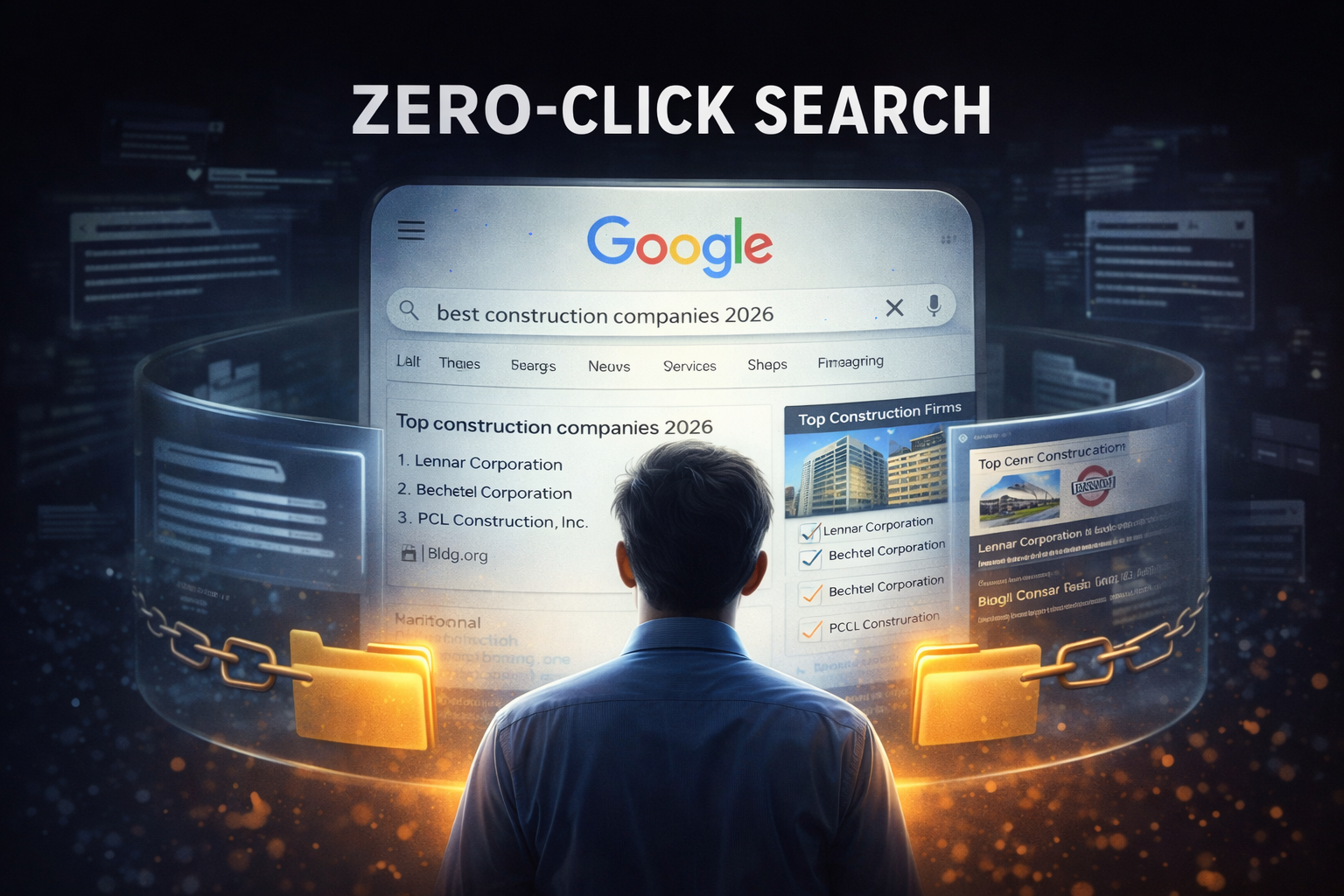
This is zero-click search, and it is no longer an edge case. According to Similarweb’s may 2025 report, zero-click searches grew from 56% to 69% of all Google queries in just one year following the rollout of AI Overviews. That means nearly 7 out of 10 searches now end without a single click to any website.
What the data actually shows
The scale of the shift is significant enough that major research firms have started tracking it closely.
A Bain and Company survey found that 80% of consumers now rely on zero-click results in at least 40% of their searches, and that this behavior is reducing organic web traffic by an estimated 15% to 25% across industries.
A Pew Research Center study that tracked 68,879 actual Google searches conducted by 900 US adults found that only 8% of users who encountered an AI Overview clicked on a traditional search result, compared to 15% when no AI summary appeared. Less than 1% clicked on the links inside the AI Overview itself.
For businesses that built their lead generation around organic search traffic, these numbers represent a real shift in how visibility works.
Not all businesses are affected equally
The impact of zero-click search varies significantly depending on the type of content and the nature of the query.
Informational content takes the biggest hit. How-to guides, definitions, and general explanations are exactly the kind of content AI Overviews are built to summarize and deliver. If your website’s traffic depended heavily on those query types, the decline is likely already visible in your analytics.
Branded and transactional searches are more resilient. When someone searches for your company specifically, or when they are ready to make a purchase decision, they still tend to click through. Local service businesses, where the user ultimately needs to call or visit a provider, also show less severe impact.
The sectors seeing the sharpest declines are those where AI can fully resolve the user’s intent without a visit. Healthcare, education, insurance, and general how-to content are among the most affected categories right now.
There is a different way to think about this
The instinct for most marketers is to treat zero-click search as a problem to be fixed. The more useful framing is to recognize that visibility itself has changed. A click is no longer the only way a potential customer encounters your brand.
Research from Seer Interactive found that brands cited in AI Overviews earn 35% more organic clicks and 91% more paid clicks than non-cited brands on the same queries. Being the source that AI trusts enough to reference is worth more than holding a position in the traditional results.
This shifts the strategic priority from ranking to being recognized as an authoritative source. It is a meaningful distinction. Ranking is about matching keywords. Authority is about demonstrating expertise that search systems, and now AI systems, consistently trust.
What businesses can do about it
There is no single fix, but there are a few directions that consistently make a difference.
Understand your current exposure
Before changing anything, it helps to know which parts of your search traffic are most at risk. An audit of your current keyword mix, looking at how many queries are informational versus transactional, gives you a clear picture of where you are vulnerable. Our audit and diagnosis service is designed exactly for this, helping organizations understand their current visibility gaps before making strategic decisions.
Build content that earns citations, not just rankings
AI systems cite sources that answer questions clearly and completely. Content structured around specific questions, with direct answers in the first paragraph, consistent expertise signals across platforms, and proper schema markup, is far more likely to be referenced in AI-generated summaries than content optimized purely for keywords.
This is the core of what we cover in our Adaptive Search Everywhere Optimization work. The approach focuses on building visibility across all the environments where buyers now look for information, not just traditional search results pages.
Train your team to work with AI, not just around it
Zero-click search is one symptom of a broader shift: AI is now embedded in how people find and evaluate information. Organizations that build internal capability around AI, knowing how to create content that AI cites, how to use AI tools to improve operational efficiency, and how to adapt marketing strategies as these systems evolve, are better positioned than those still treating AI as a peripheral concern.
Our AI Business Training programs help teams build exactly this kind of practical, day-to-day AI capability. From understanding how AI search systems evaluate content to building repeatable workflows, the programs are structured around real business operations, not generic tool overviews.
The bigger picture
Zero-click search is not a temporary anomaly. It reflects a structural change in how AI is integrated into the search experience. Google is building a product that keeps users inside its own ecosystem for as long as possible, and AI Overviews are central to that strategy.
For businesses, the practical implication is that measuring success purely through website traffic is becoming less reliable as a proxy for brand visibility. The organizations adapting well to this shift are investing in being recognized as authoritative sources across search environments, social platforms, and AI systems, rather than chasing clicks from a single channel.
We looked at the mechanics behind this in more detail in our post on why some websites appear in Google AI Overviews and others do not, which covers what actually determines whether a site gets cited.
Frequently Asked Questions
What is zero-click search?
Zero-click search refers to a Google search that ends without the user clicking on any website link. This happens when the search results page itself provides a satisfactory answer, typically through an AI Overview, featured snippet, knowledge panel, or similar on-page element. As of mid-2025, roughly 69% of Google searches end this way.
Is zero-click search bad for all businesses?
Not equally. Businesses that rank for transactional, branded, or local-intent queries tend to be less affected than those that relied heavily on informational content for traffic. The businesses most at risk are those whose top-performing pages answered general questions that AI can now summarize directly.
Can my website still get traffic if AI Overviews are showing for my keywords?
Yes, but the strategy needs to shift. Websites that are cited as sources within AI Overviews actually see higher click-through rates than non-cited sites on the same queries. The focus should be on becoming a recognized authority that AI systems choose to reference, rather than on outranking competitors in traditional results.
How do I know how much of my traffic is affected by zero-click search?
Google Search Console is the most direct tool for this. If your impressions are growing but clicks are flat or declining, zero-click behavior is likely a factor. Comparing click-through rates for informational versus transactional queries gives you a clearer picture of where the exposure is concentrated.
If you want to understand how zero-click search is affecting your current visibility and what a practical response looks like for your business, the WSI team can help you evaluate where you stand. Start the conversation here.