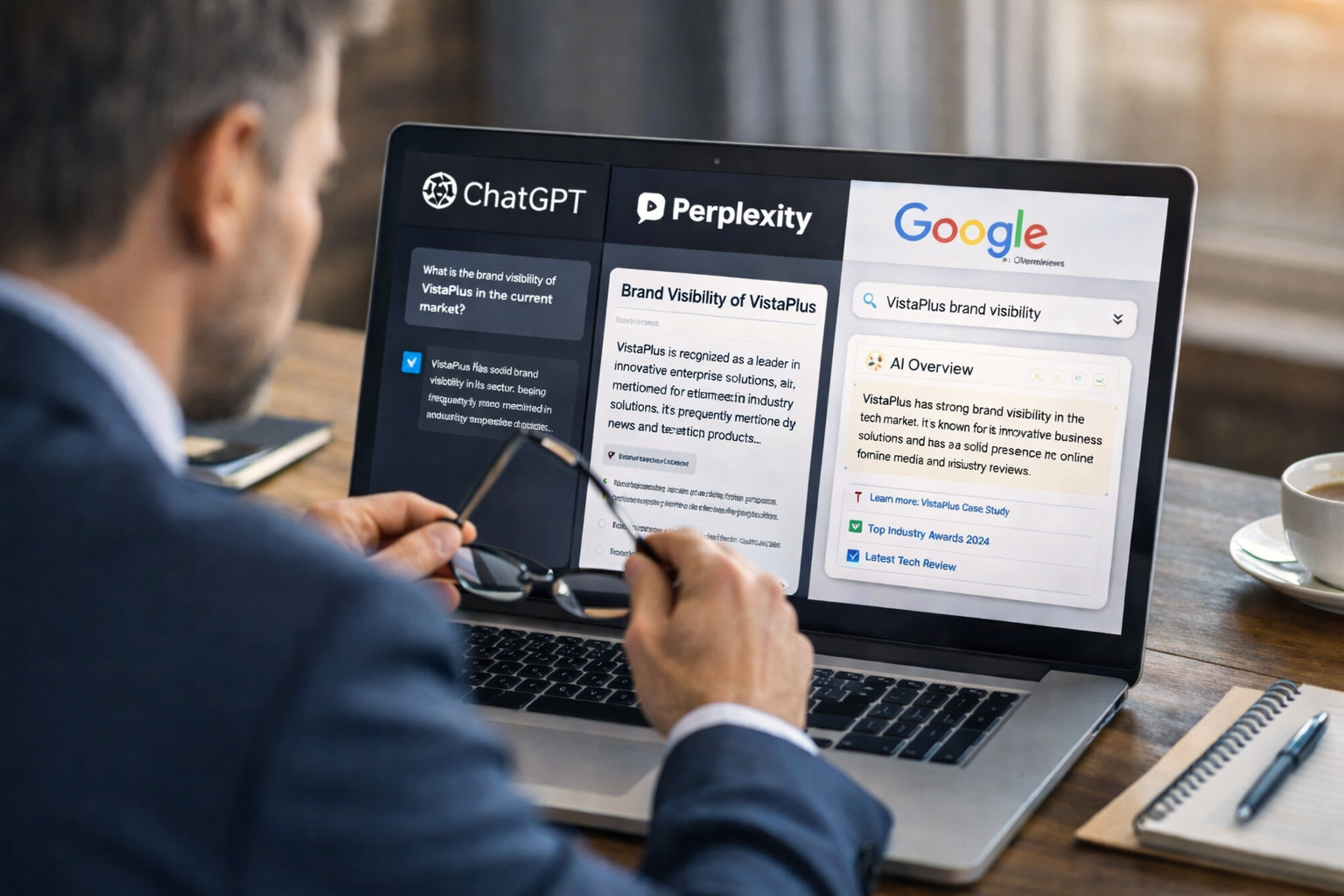
Brand visibility in AI search is now one of the most discussed topics among marketing leaders and business owners. The question is no longer whether people use ChatGPT, Perplexity, or Google AI Overviews to find products and services. They do. The real question is whether your business shows up when they ask.
A 2026 analysis by ALM Corp of 1,000 enterprise brands found that 62% were invisible to AI search tools despite heavy investment in traditional SEO. That is not a fringe problem. It is the current reality for the majority of businesses that have not yet adapted their digital strategy to how AI systems select and recommend sources.
This post explains why brand visibility in AI search works differently from traditional search rankings, and what the gap between the two is actually costing businesses right now.
Why brand visibility in AI search is not the same as ranking on Google
Many businesses assume that strong Google rankings translate into visibility across AI platforms. That assumption is incorrect.
Google ranks pages based on backlinks, domain authority, and keyword relevance. AI systems like ChatGPT and Perplexity select sources based on a different set of signals: how often a brand appears across independent third-party sources, how clearly its expertise is defined, and how consistently that expertise is demonstrated across the web.
Community discussions on platforms like Am I Cited capture the frustration directly. Business leaders with established brands, thousands of customers, and solid Google rankings discover their company simply does not exist in AI-generated answers. Competitors they consider smaller or less known appear consistently. The explanation is almost always the same: those competitors built a broader external presence that AI systems can triangulate and trust.
The scale of the shift in search behavior
Gartner predicted that traditional search volume would drop 25% by 2026 as users shift to AI assistants for discovery. That prediction now looks conservative. ChatGPT processes 2 billion queries daily. Perplexity handles 780 million queries per month. Google AI Overviews appear on nearly 25% of all searches.
These platforms are not supplementary channels anymore. For a growing share of buyers, especially in B2B categories and professional services, AI tools are the first place they go when evaluating options. Brand visibility in AI search has become a primary business development issue, not a secondary marketing concern.
What determines brand visibility in AI search environments
AI systems build confidence in a brand by finding consistent signals across multiple independent sources. Your own website is only one input.
Third-party presence matters more than owned content
Research from AirOps’ 2026 State of AI Search found that 85% of brand mentions that feed into AI citations come from third-party pages, not from a company’s own website. AI does not trust what you say about yourself. It trusts what others say about you across sources it recognizes as credible.
Businesses with profiles on review platforms like G2, Trustpilot, or Capterra are three times more likely to be cited by ChatGPT than those without such presence. Brands mentioned regularly in industry forums and community platforms like Reddit are four times more likely to appear in AI responses.
Content clarity and structure signal trustworthiness
AI systems parse content the same way a first-time visitor does. If your homepage uses vague language like ‘innovative solutions’ or ‘cutting-edge platform’ without clearly stating what you do, who you serve, and what problems you solve, AI cannot build accurate associations for your brand.
Content that leads with direct answers, uses clear headings, includes FAQ sections, and references data from credible external sources performs significantly better in AI citation environments. Content with statistics and quotations achieves 30 to 40% higher visibility in AI responses than content without them.
Content freshness affects citation probability directly
Pages updated within two months earn 28% more AI citations than older content. Quarterly updates reduce citation loss significantly. Content freshness functions as a trust signal because it tells AI systems the source is actively maintained and reflects current information.
The hidden cost of poor brand visibility in AI search
Businesses that measure their digital performance only through Google Analytics are missing a growing portion of how buyers discover and evaluate them.
AI referral traffic converts at 14.2% compared to Google’s 2.8%, making each AI-referred visit roughly five times more valuable per session. Brands cited in AI Overviews earn 35% more organic clicks and 91% more paid clicks than non-cited brands on the same queries.
The inverse is also true. When a competitor appears in an AI-generated answer and you do not, the buyer receives a pre-validated recommendation before your brand is ever considered. That is not just lost traffic. It is a buyer who arrived at a decision without you ever entering the conversation.
We covered the traffic dimension of this shift in our post on what happens when Google answers and nobody visits your site, which explains why the traditional click metric no longer captures the full picture of digital visibility.
What most businesses get wrong when they try to fix this
When business leaders realize their brand is invisible in AI search, the instinct is usually to produce more content. That response misses the actual problem.
More content on your own domain is not the answer
Publishing additional pages on your website does not address the core issue. AI systems already have a clear picture of your owned domain. What they lack is external corroboration from sources they trust independently.
Distributing content to a wide range of credible publications can increase AI citations by up to 325% compared to publishing the same content only on your own site. One article placed in a respected industry publication does more for AI visibility than ten articles published exclusively on your blog.
Inconsistent brand identity creates AI confusion
When your messaging, positioning, and descriptions vary across your website, LinkedIn, review platforms, and press mentions, AI systems struggle to build a clear entity definition for your brand. They default to sources they can classify with confidence.
Consistent use of the same language to describe what you do, who you serve, and what problems you solve across every digital touchpoint is a foundational requirement for AI visibility. AI also covers why some websites appear in AI Overviews and others do not in our earlier post on how AI search visibility works, which digs into the underlying mechanics in more detail.
How WSI builds brand visibility in AI search environments
The right starting point is always a clear picture of where you stand today. Most organizations do not have an accurate view of how they appear across AI platforms, which external sources reference them, and how those signals compare to their competitors.
Our audit and diagnosis service gives organizations exactly that picture. It maps current visibility gaps across both traditional search and AI environments, and identifies the specific signals that need strengthening before any broader strategy is built.
From there, our Adaptive Search Everywhere Optimization work builds the external presence, content structure, and platform consistency that AI systems need to recognize and trust your brand. This is not traditional SEO. It is a strategy designed specifically for how discovery now works across AI platforms.
For organizations that want strategic guidance on how AI fits into their broader business operations, not just their marketing visibility, our AI consulting work addresses both dimensions in a way that connects external visibility with internal capability development.
Frequently Asked Questions
Why does my brand not appear in ChatGPT if we rank well on Google?
Google rankings and AI search visibility use different selection criteria. Google evaluates backlinks, domain authority, and keyword relevance. ChatGPT and Perplexity evaluate citation frequency across independent sources, brand consistency, and content structure. A strong Google ranking does not transfer automatically to AI visibility.
How long does it take to improve brand visibility in AI search?
Improvements to content structure and FAQ schema can influence citation visibility in Perplexity and Google AI Overviews within a few weeks. Building broader third-party authority through earned media and review platform presence takes three to six months to produce consistent results in ChatGPT and similar platforms.
Does my company need to be on social media to appear in AI search?
Social media is one contributor but not the primary one. LinkedIn is the most cited domain for professional queries across AI platforms. Review sites, industry publications, and community forums carry significant weight. The core requirement is a consistent presence across multiple credible external sources, not social activity for its own sake.
Is there a way to pay for brand visibility in AI search?
Not in the traditional sense. ChatGPT, Perplexity, and Google AI Overviews do not currently offer paid placement the way Google Ads does. AI visibility is earned through consistent authority signals across the web. Some platforms are experimenting with sponsored placements, but organic citation authority remains the primary driver of brand visibility in AI search today.
If you want to understand where your business stands today in AI search environments, and what it would take to build real brand visibility in AI search, the WSI team is ready to help. Start the conversation here.