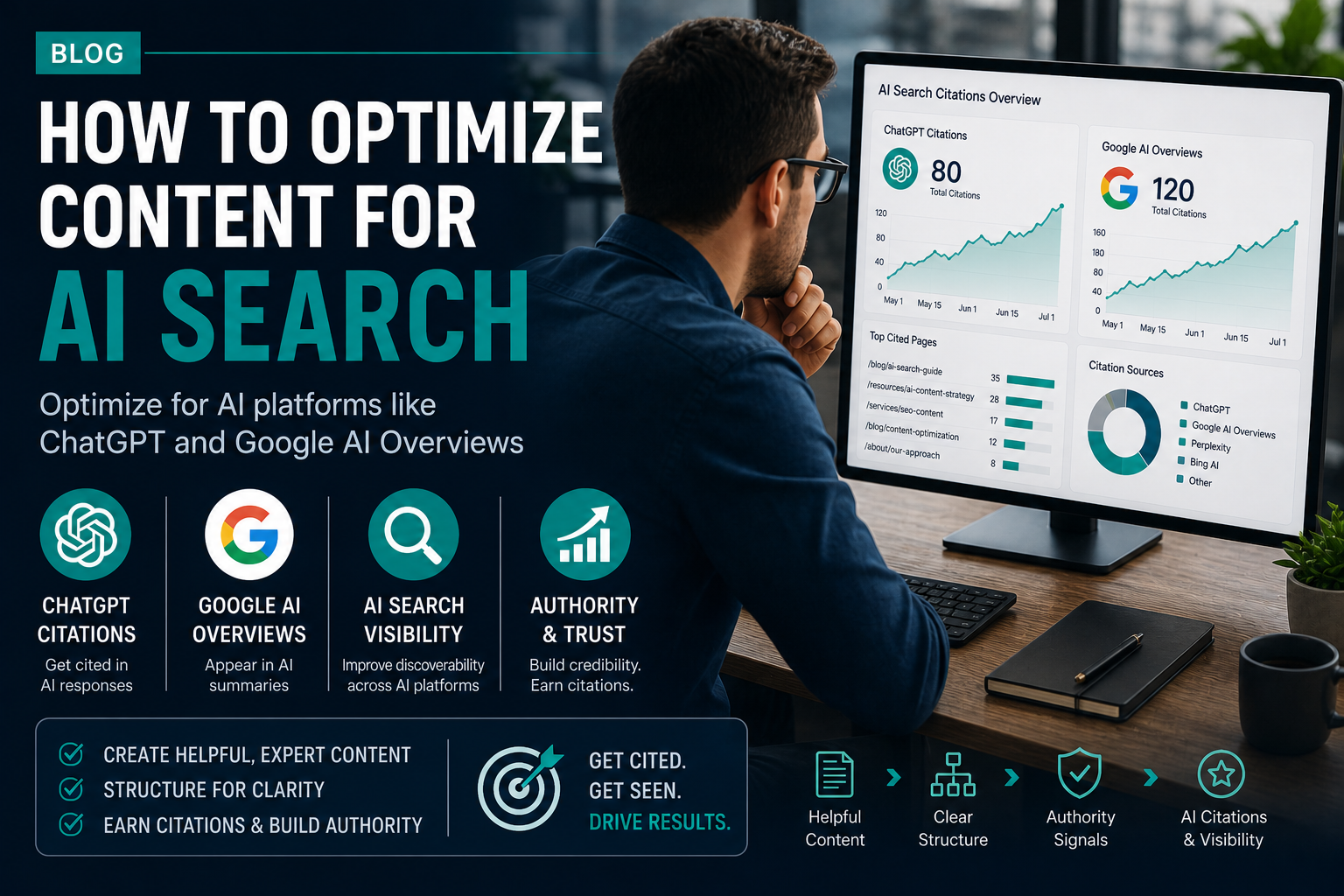
Businesses that optimize content for AI search are gaining a measurable advantage. Those that do not are watching competitors appear in answers their buyers trust, before those buyers ever visit a website. The gap is real, and the data from 2025 and 2026 makes the stakes very clear.
AI referral traffic grew 527% year over year as of August 2025, according to Search Engine Land data cited by Position Digital. ChatGPT alone now drives 87.4% of all AI referral traffic across the web. Visitors from AI platforms spend 68% more time on websites than visitors from traditional organic search. They also convert at significantly higher rates.
The question is no longer whether AI search matters. It is whether your content gives AI systems enough to work with to surface your business when it counts.
Why traditional SEO is no longer enough to optimize content for AI search
Strong Google rankings and AI search visibility now follow different rules. A business can sit in position one for its most important keyword and still be invisible in ChatGPT, Perplexity, and Google AI Overviews.
According to Omnibound’s analysis of 55+ AI search data points, 94% of B2B buyers used generative AI tools during their purchase process in 2025. These buyers form opinions before they visit a website. They use AI to compare options, validate expertise, and narrow their shortlist. If your business does not appear in those answers, you miss that moment entirely.
The old model rewarded businesses that ranked. The new model rewards businesses that get cited. Those are different outcomes built on different signals.
The citation gap most businesses have not measured yet
ChatGPT only cites 50% of the pages it retrieves during a search. 28.3% of ChatGPT’s most cited pages have zero organic visibility in Google.
That second number is striking. A meaningful share of AI-cited content never ranks in traditional search at all. AI systems evaluate content independently of Google’s ranking signals. Businesses that only optimize for Google are optimizing for a narrower audience than they think.
What AI systems actually look for when they optimize content citations
The research on AI citation behavior is now detailed enough to draw clear patterns. These are the factors that consistently drive inclusion in AI-generated answers.
Content structure and answer-first writing
44% of all AI citations come from the first 30% of a page. AI systems extract answers from the top of content first. Articles that bury the main point after a long introduction lose citation opportunities before the AI ever reaches the useful part.
Pages structured into sections of 120 to 180 words earn 70% more citations than pages with very short or unstructured sections. Clear headings, concise paragraphs, and FAQ sections all help AI systems identify and extract what is most relevant.
Content depth and the use of credible data
Semantic completeness has a correlation coefficient of 0.87 with AI citation frequency. In plain terms: content that covers a topic thoroughly from multiple angles scores far higher than content that covers it shallowly.
Articles over 2,900 words are 59% more likely to be cited by ChatGPT than articles under 800 words. Content that includes statistics, citations, and quoted sources achieves 30 to 40% higher visibility in AI responses. Depth and evidence are not optional extras. They are selection criteria.
Freshness matters more than most teams realize
Pages updated within two months earn 28% more AI citations than older content. Ahrefs found that the average AI-cited page is nearly a full year newer than pages that appear only in traditional search results.
Freshness signals to AI systems that a source is actively maintained and reflects current information. Content that was excellent in 2023 but has not been reviewed since loses ground steadily against content that gets updated regularly.
The off-site signals that help you optimize content for AI search
Optimizing content for AI search is not only about what sits on your website. It is also about how your brand and expertise appear across the broader web.
According to Superlines’ analysis of 60+ AI search statistics, domain authority is the number one predictor of AI citations, with a SHAP value of 0.63. High-traffic sites earn three times more AI citations than low-traffic sites. The same research found that citation volumes can differ by 615x between AI platforms for the same brand, proving that no single platform strategy is sufficient.
Third-party validation carries three times the weight of backlinks
Brand mentions now carry three times more weight than backlinks for AI visibility. Businesses with profiles on review platforms like G2, Trustpilot, and Capterra are three times more likely to be cited by ChatGPT than those without such presence.
Domains with significant brand mentions on Quora and Reddit have roughly four times higher chances of being cited than those with minimal community presence. AI systems use these signals to triangulate whether a brand is genuinely recognized as authoritative across independent sources.
We explored the full picture of how trust signals work across AI platforms in our post on authority in AI search, which covers what actually determines whether a brand gets cited or ignored.
What happens when businesses fail to optimize content for AI search
Businesses that ignore AI search optimization face a specific kind of invisibility. Their content exists. It may even rank on Google. But it does not appear in the answers buyers trust at the moment they are forming opinions.
Zero-click rates reach 83% when AI Overviews appear in search results. That means 83 out of 100 people who see an AI-generated answer never click through to any website. The brand that appears in the answer shapes the buyer’s thinking. Brands that do not appear are absent from that conversation entirely.
The business consequence is quiet but significant. Proposals that never come in. Shortlists the company never made. Competitors who got to shape the buyer’s thinking first. The CRM does not track what never arrived.
We covered the traffic side of this problem in more depth in our posts on zero-click search and brand visibility in AI search, both of which address what the shift means for businesses still measuring performance only through traditional analytics.
How WSI helps businesses optimize content for AI search
Optimizing content for AI search is not a one-time change. It is an ongoing strategy that requires understanding where your visibility currently stands, which signals are missing, and how to build authority across the platforms AI systems actually draw from.
Our audit and diagnosis service gives organizations a clear starting point. It maps current AI visibility across ChatGPT, Perplexity, and Google AI Overviews, identifies where authority signals are weak, and surfaces the specific gaps blocking citation visibility in the most important query areas.
From there, our Adaptive Search Everywhere Optimization work builds the content structure, external presence, and platform consistency that AI systems use to select and trust sources. This includes content restructuring, off-site authority development, schema implementation, and a freshness strategy that keeps content competitive over time.
For organizations that also want to understand how AI fits into their broader business operations, our AI consulting work connects external visibility strategy with internal capability development.
Frequently Asked Questions
What does it mean to optimize content for AI search?
Optimizing content for AI search means structuring and positioning your digital content so that AI platforms like ChatGPT, Perplexity, and Google AI Overviews select it as a credible source when generating answers. It includes content structure, answer-first writing, depth, freshness, schema markup, and building external authority signals across third-party platforms.
Does optimizing content for AI search hurt traditional SEO?
No. The two approaches are complementary. Strong technical SEO foundations, quality content, and credible backlinks all support AI search visibility as well as traditional rankings. The main addition is a broader focus on external authority signals, content freshness, and answer-oriented structure that traditional SEO alone does not address.
How long does it take to see results from AI search optimization?
Structural changes to content, such as adding answer-first introductions, FAQ sections, and schema markup, can influence citation visibility in weeks. Building broader third-party authority through earned media and review platforms takes three to six months to produce consistent results. A full AI search visibility strategy is a sustained investment, not a one-time fix.
Which AI platforms should we prioritize when optimizing content?
ChatGPT drives 87.4% of all AI referral traffic, making it the highest-priority platform for most businesses. Google AI Overviews reach two billion monthly users across 200 countries and deserve equal attention. Perplexity accounts for roughly 15% of AI referral traffic and is particularly important in research-heavy categories. Citation volumes differ significantly across platforms, which is why a multi-platform approach consistently outperforms single-platform optimization.
If you want to understand where your content currently stands in AI search environments and what it would take to build real citation visibility, the WSI team can help you evaluate your position and define a practical path forward. Start the conversation here.