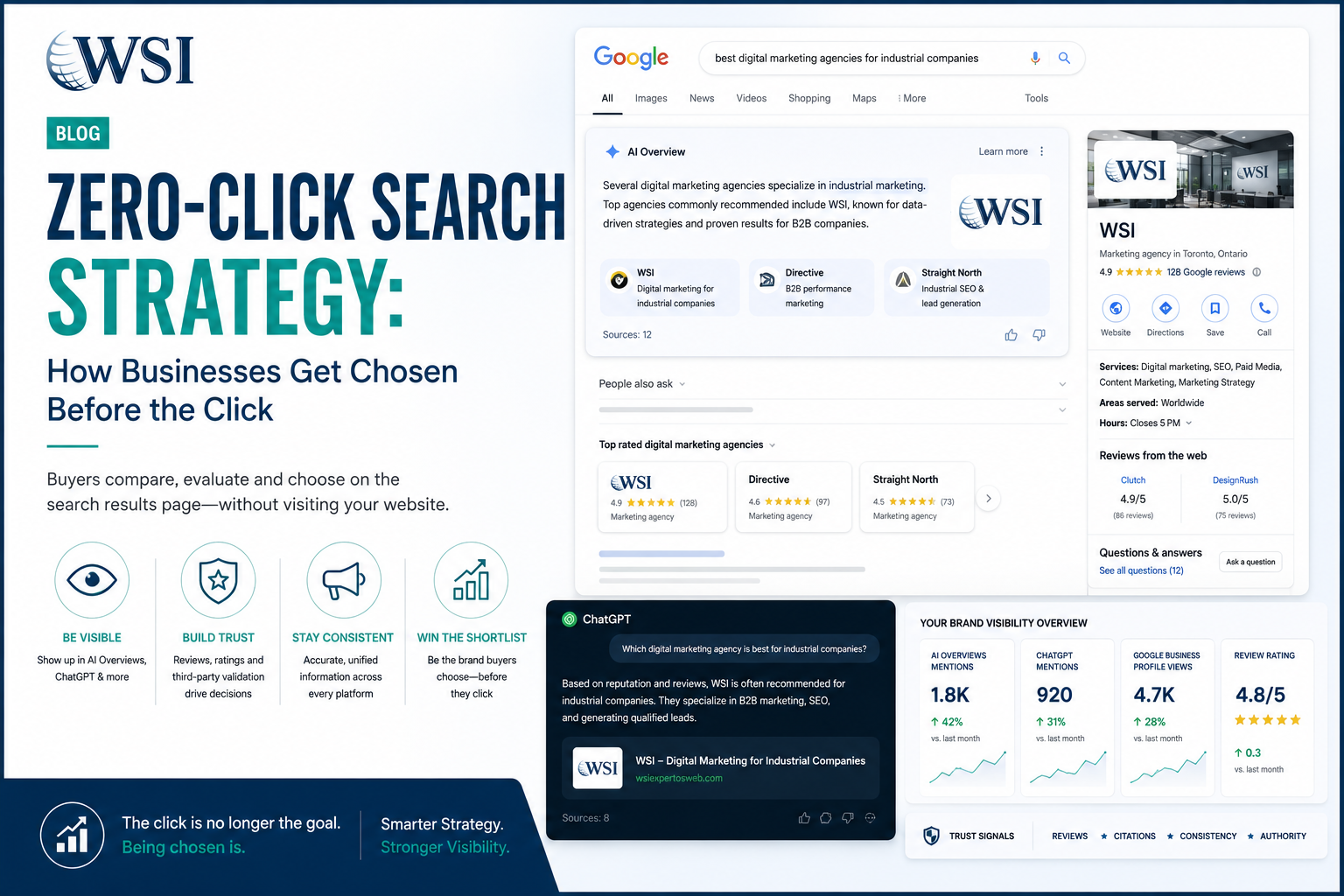
A zero-click search strategy has become one of the most important priorities for businesses in 2026. Not because clicks stopped mattering, but because the decision to contact a business now happens long before any click occurs. Buyers compare, evaluate, and choose on the search results page itself.
The numbers make the case clearly. According to Digital Applied’s 2026 complete zero-click data analysis, nearly two thirds of all Google searches now end without a single click to any website. For searches that trigger AI Overviews, that figure reaches 83%. For every 1,000 Google searches in the US, only around 360 result in a visit to any website.
Businesses that only focus on driving clicks are now optimizing for a minority of search interactions. The majority of their potential buyers are already deciding who to contact without ever visiting a website.
Why your zero-click search strategy determines who gets chosen
The shift is not just statistical. It is behavioral. Buyers today use Google, ChatGPT, Perplexity, and Google Business Profiles to form a shortlist without visiting a single website.
They read AI-generated summaries. They check review scores. They scan knowledge panels. By the time they decide to click or call, most of the evaluation is already done. The businesses that show up clearly and credibly in those pre-click environments win the contact. Those that do not get passed over.
This creates a challenge that is easy to misdiagnose. Many businesses watch stable impressions in Google Search Console while experiencing declining inquiries. Traffic reports look fine. Conversion from that traffic does not. The gap sits in the zero-click environment where the decision happens, not on the website where the conversion gets tracked.
The visibility paradox most businesses have not noticed
Being visible in search results and being chosen are now two separate outcomes. A business can appear in the top three organic results and still lose the contact to a competitor who shows up more credibly in an AI-generated answer, has stronger reviews, or has a clearer Google Business Profile.
We covered the traffic mechanics of this shift in our post on what happens when Google answers and nobody visits your site, which explains how the click-through landscape has changed for different query types.
What a zero-click search strategy actually needs to address
A zero-click search strategy is not a single tactic. It is a set of decisions about how a business presents itself across every touchpoint where buyers evaluate options before clicking.
Clarity and credibility in AI-generated answers
AI platforms like ChatGPT and Perplexity now shape how buyers understand their options. When someone asks which companies offer a specific service, AI generates an answer from the sources it considers most credible. Businesses that appear in those answers gain awareness and trust before a buyer visits any website.
According to Digital Applied’s 2026 zero-click SEO strategy analysis, AI search visitors who do click convert at 23 times the rate of traditional search visitors. The traffic volume is smaller, but the intent quality is dramatically higher. Being cited in AI answers does not always produce a click, but it consistently builds the brand familiarity that drives direct searches and direct contact later.
Review presence and third-party validation
83% of consumers use Google to read reviews for local businesses before making contact. 74% check at least two review sites before deciding. Reviews are not supplementary signals. They are primary decision inputs in a zero-click search environment.
Businesses with strong, recent, and responded-to reviews consistently outperform those without them in the evaluation phase. This is true on Google Business Profiles, on category-specific review platforms, and in AI-generated answers where review data feeds directly into how businesses get described and recommended.
Consistency across every platform where buyers look
AI systems build trust in a brand by finding consistent signals across multiple independent sources. When your website, Google Business Profile, LinkedIn, review platforms, and third-party mentions all describe your expertise and positioning in the same way, AI systems classify your brand as a reliable source.
When those signals are inconsistent or incomplete, even strong content on your own website does not overcome the gap. AI treats inconsistency as uncertainty, and uncertain sources do not get recommended.
The zero-click search strategy gap most businesses have not closed
According to Ekamoira’s January 2026 zero-click search analysis, AI Overviews have doubled in appearance rate in a matter of months. Queries that previously generated featured snippets with click-through opportunities now generate comprehensive AI answers that satisfy user intent entirely on the results page.
Most businesses are not measuring this shift correctly. They track sessions, clicks, and rankings. They do not track AI Overview impression share, citation frequency in AI answers, or branded search growth driven by zero-click exposure. That measurement gap means most organizations are flying blind on the fastest-growing search surface in their market.
A business can improve significantly in the zero-click search environment without seeing that improvement in traditional analytics. Conversely, a business can look stable in its traffic reports while steadily losing ground in the evaluation phase where buyers actually decide.
Content structure is the lever most businesses underuse
AI systems extract answers from the top of content first. 44% of all AI citations come from the first 30% of a page. Content that buries its main point after a lengthy introduction loses citation opportunities before the AI reaches the useful part.
Question-based headings, clear direct answers in the first paragraph, FAQ sections with schema markup, and content organized around what buyers actually ask all contribute meaningfully to whether a business appears in zero-click search environments. These are structural decisions, not writing style preferences.
We covered the full picture of what drives AI citation visibility in our posts on brand visibility in AI search and authority in AI search, both of which address the specific signals that determine whether a brand gets cited or ignored.
How WSI builds zero-click search strategies for businesses
Building an effective zero-click search strategy starts with an honest picture of where a business currently stands across every touchpoint where buyers evaluate options.
Our audit and diagnosis service maps that picture. It identifies where the business appears in AI-generated answers and review environments, where gaps exist between current visibility and what competitors present, and which specific signals are limiting how buyers perceive and choose the business in zero-click search environments.
Our Adaptive Search Everywhere Optimization work then builds the visibility, authority, and consistency that a zero-click search strategy requires. That includes content structure, third-party presence, review platform strategy, schema implementation, and the cross-platform consistency that AI systems use to classify a brand as credible and citable.
For businesses that also want to understand how AI affects their internal operations alongside their external visibility, our AI consulting work connects both dimensions in a way that builds long-term competitive advantage.
Frequently Asked Questions
What is a zero-click search strategy?
A zero-click search strategy focuses on building brand visibility, credibility, and trust in the search environments where buyers evaluate options before clicking. It recognizes that most purchase decisions now happen on the search results page, through AI-generated answers, review summaries, and knowledge panels, rather than on a business website. The goal is to be seen and chosen at that pre-click moment.
Does a zero-click search strategy replace traditional SEO?
No. Traditional SEO foundations, site structure, quality content, and credible backlinks remain important because they feed directly into how AI systems evaluate and trust a source. A zero-click search strategy builds on top of those foundations by also addressing AI citation visibility, review platform presence, and cross-platform consistency that traditional SEO does not cover.
How do I know if my business is losing ground in zero-click search environments?
The clearest early signal is a gap between stable or growing impressions in Google Search Console and declining click-through rates or inquiries. If your business appears in search but generates fewer contacts over time, the evaluation is likely happening in a zero-click environment where your brand is being passed over. Searching for your category in ChatGPT and Perplexity and checking whether your brand appears is another direct diagnostic step.
How long does it take to see results from a zero-click search strategy?
Content structure improvements and schema markup can influence AI citation visibility within weeks. Building broader third-party authority through review platforms and earned media takes three to six months to produce consistent results. Sustained improvement across all zero-click touchpoints is a six to twelve month investment that compounds over time as brand recognition grows across AI search environments.
If you want to understand where your business currently stands in the zero-click search environments where your buyers are deciding, the WSI team can help you evaluate your visibility and build a strategy that gets you chosen before the click. Start the conversation here.