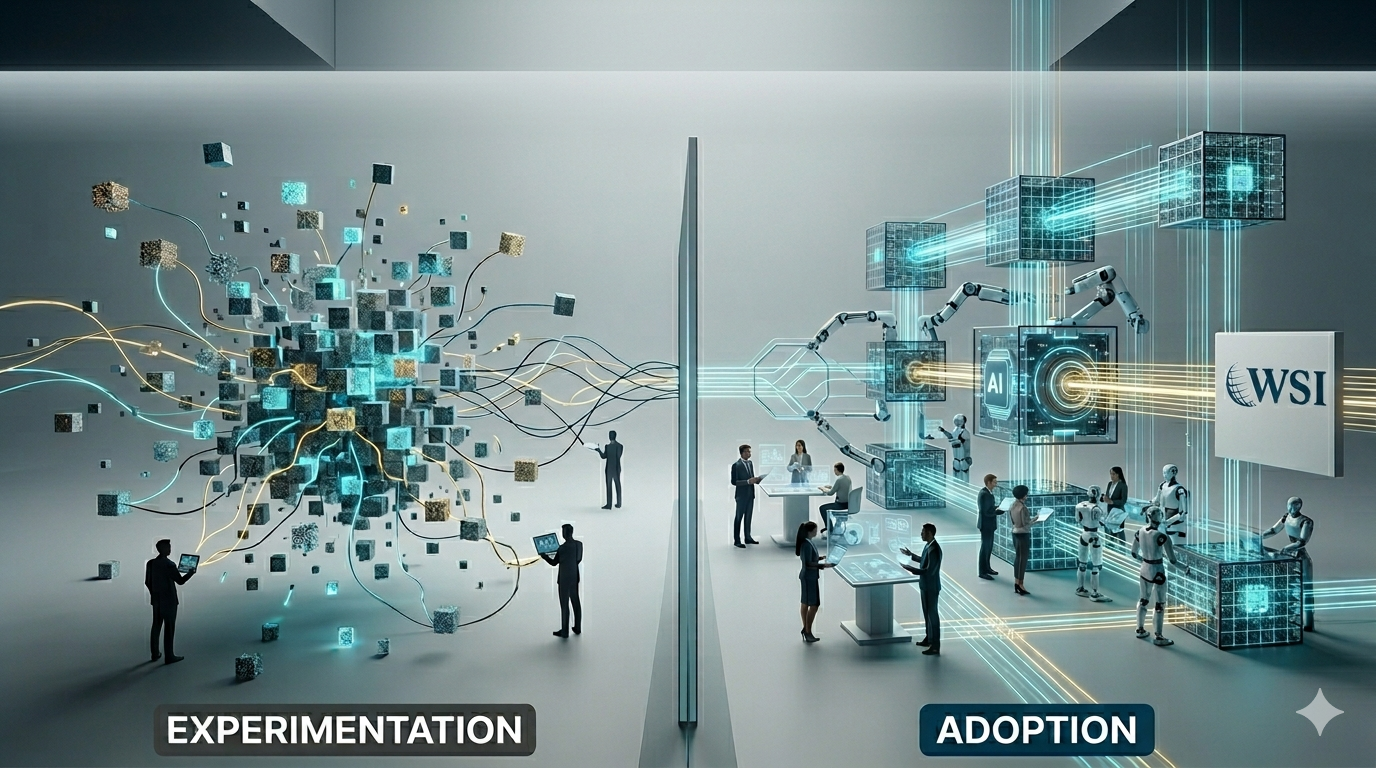
Most organizations say they are working with AI. Fewer can point to results. This gap between AI experimentation and AI adoption is where most organizations struggle.
Everyone is experimenting. Not everyone is adopting.
Ask almost any business leader today whether their company is using AI and the answer is yes. A few people on the marketing team use ChatGPT. Someone in operations tried an automation tool. The IT department ran a pilot last quarter.
That is experimentation. It is a reasonable starting point, but it is not adoption.
According to Gartner, at least 30% of generative AI projects are abandoned after proof of concept, and only 48% of AI projects make it to production. The tools are there. The structured approach usually is not.
What experimentation looks like in practice
Experimentation tends to share a few common characteristics across organizations.
- Individual employees or small teams try tools on their own, without a shared framework for how to use them.
- Results vary depending on who is doing the experimenting and how much time they put into it.
- There is no way to measure the impact because no baseline was set and no outcomes were defined.
- Knowledge stays with the individual. When they move on, so does whatever progress was made.
None of this means experimentation is bad. It is how most organizations discover what AI can do for them. The problem is when experimentation becomes the permanent state.
What adoption actually requires
Adoption is what happens when AI moves from individual curiosity to shared practice. It requires a few things that experimentation typically skips.
A clear definition of where AI should be used
Adopted organizations have made deliberate decisions about which workflows benefit from AI and which do not. They are not trying to use AI everywhere. They have identified the specific tasks where it produces better or faster outcomes and built their approach around those.
Shared practices across teams
When AI is truly adopted, people across the organization use it in consistent ways. There are shared prompting frameworks, common standards for reviewing AI outputs, and a clear understanding of where human judgment still needs to lead.
This consistency does not happen by accident. It comes from structured training. BCG’s AI at Work 2025 report, based on 10,600 workers across 11 countries, found that 79% of employees who received more than five hours of AI training became regular users, compared to 67% of those with less training. Only 36% of employees say the training they have received is enough.
A way to measure what is working
Organizations that have moved past experimentation track outcomes. They know which processes have improved, by how much, and what AI is actually contributing. This is what makes it possible to invest more in what works and stop doing what does not.
Why most companies stay stuck in experimentation
Staying in experimentation mode is rarely a conscious decision. It happens for a few predictable reasons.
There is no one accountable for AI adoption. Tools get used by whoever is motivated to use them, but there is no internal owner responsible for making it work at scale.
Training is shallow or nonexistent. People get access to tools but no guidance on how to use them in the context of their actual work. The result is inconsistent quality and low confidence. BCG found that only a quarter of frontline workers say their leaders truly support AI adoption, and that leadership backing is one of the strongest predictors of whether employees actually use AI consistently.
There is no roadmap. Without a plan that connects AI use to specific business objectives, it is hard to know whether the organization is making progress or just staying busy. Gartner’s research points to unclear business value as one of the top reasons GenAI projects get abandoned after the pilot phase.
How to move from one to the other
The shift from experimentation to adoption does not require a large budget or a technology overhaul. It requires structure and intention.
Organizations that make this shift well usually start by taking stock of where AI is already being used and what results it is producing. From there, they identify two or three workflows where structured adoption would have the most impact and build their practices around those first.
Structured training plays a big role here. Not generic AI training, but training built around the specific tasks and roles in that organization. Our AI Business Training programs are designed exactly for this, helping teams move from sporadic tool use to consistent, repeatable AI workflows across departments.
For organizations that want outside perspective on where to focus and how to build the roadmap, our AI consulting work covers that part of the process. We also wrote about what that engagement looks like in more detail in our post on what an AI consultant actually does.
The difference between experimenting with AI and adopting it is not technical. It is operational. Organizations that move into structured adoption are the ones that start seeing measurable impact.
Frequently Asked Questions
How do I know if my company is experimenting or actually adopting AI?
A good test is whether AI use is consistent across your team or dependent on specific individuals. If only certain people use AI, if there are no shared standards for how it gets used, and if you cannot point to measurable outcomes, your organization is most likely still in the experimentation phase.
Is experimentation a waste of time?
Not at all. Experimentation is how organizations learn what AI can do for them. The issue is when it becomes the default state instead of a stepping stone toward structured adoption. The goal is to take what you learn from experimentation and build something more deliberate around it.
How long does it take to move from experimentation to adoption?
It depends on the size of the organization and how many workflows are in scope. Focused programs that start with two or three high-impact use cases can produce visible results within weeks. Broader organizational adoption typically develops over two to six months, depending on how structured the training and implementation process is.
Do all employees need AI training for adoption to work?
Not necessarily all at once. Most organizations start with the teams where AI can have the most immediate impact and expand from there. What matters is that training is role-specific and tied to real workflows, not a generic overview of what AI tools exist.
If your organization is ready to move past experimentation and build something more structured, the WSI team can help you define the right path forward. Start the conversation here.