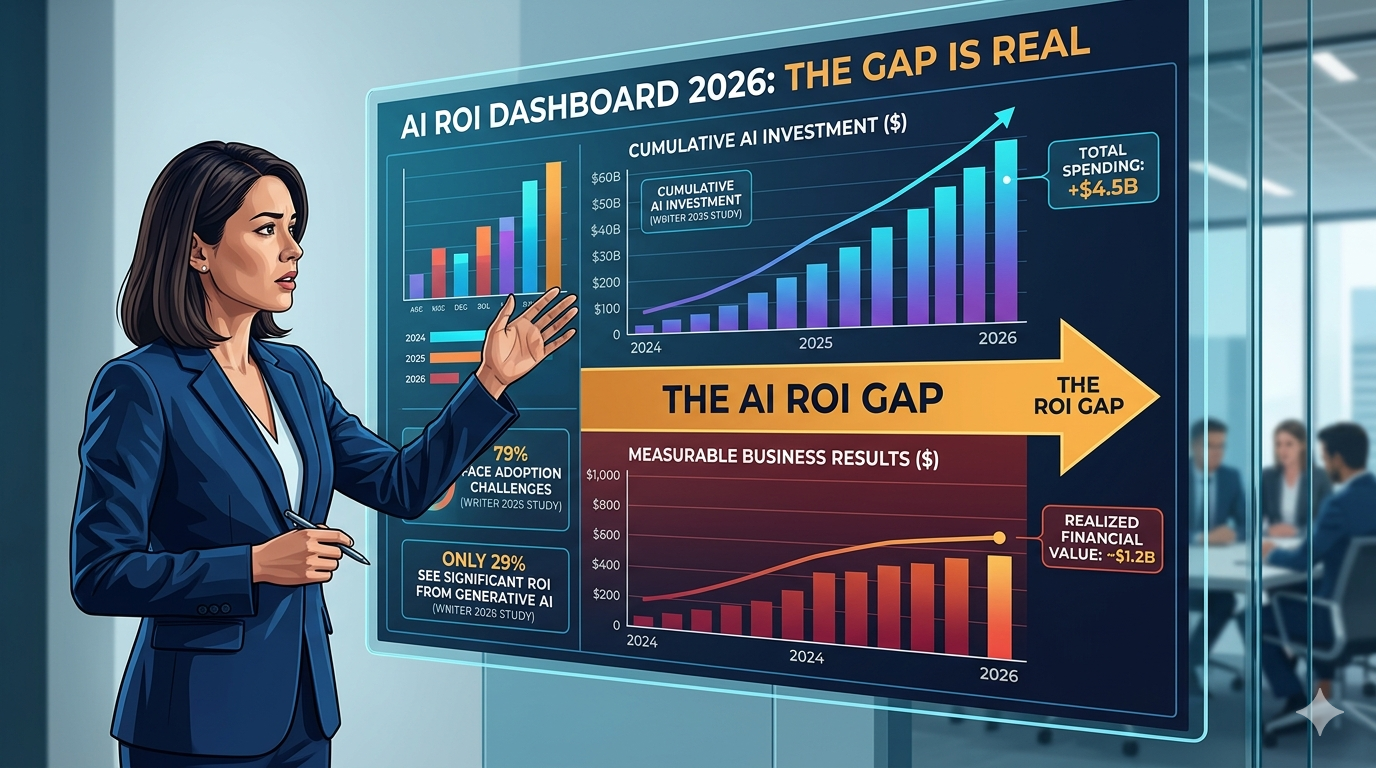
AI ROI for business is the conversation that defines 2026. Companies are spending more on AI than ever before. Yet most of them cannot point to real financial results. That gap is now one of the most widely discussed topics in boardrooms, finance forums, and executive leadership communities around the world.
A new study by Writer covering enterprise AI adoption in 2026 surveyed executives across industries and found that 79% of organizations face challenges in adopting AI. That number is up significantly from the year before. More striking: 54% of C-suite executives say adopting AI is tearing their company apart.
This is not a fringe finding. It reflects a structural problem that most organizations have not yet addressed. And it starts well before the technology.
The AI ROI gap for business is not a technology problem
Most executives assume that poor AI results come from choosing the wrong tools. The data says otherwise.
According to Harvard Business Review’s February 2026 analysis of industry data, 88% of companies report regular AI use. Performance gains plateau for most of them. Employees experiment with new tools but do not integrate them into how work actually gets done. That leaves executives increasingly concerned about the return on investment.
The problem is structural. AI does not deliver ROI simply because it gets deployed. It delivers ROI when it gets embedded into how teams work, with shared practices and clear accountability for outcomes.
Individual wins do not equal organizational returns
The Writer study found that AI super-users deliver five times more productivity than non-AI users. That sounds like a success. But only 29% of organizations see significant ROI from generative AI overall.
The gap between individual wins and organizational returns is the core challenge. One person on the team figured out how to use AI well. The rest did not. No shared frameworks exist. No process was redesigned. The productivity gain stays isolated and never compounds across the organization.
Why AI ROI for business stalls at the pilot stage
Most organizations get stuck between experimenting and scaling. The pattern is consistent across industries and company sizes.
Speed of deployment does not equal speed of adoption
A CIO Magazine analysis of enterprise AI ROI put it directly: enterprises can quickly implement advanced models, yet adoption stalls when AI is not embedded in workflows. Employees revert to familiar processes. Managers lack confidence in AI outputs. Productivity gains stay theoretical rather than financial.
Deploying a tool and embedding it into daily operations are two completely different milestones. Most organizations celebrate the first and skip the second.
The skills gap blocks value at every level
Skills gaps now rank among the most significant barriers to AI ROI for business, according to CFO Dive’s coverage of AI challenges in 2026. The issue is not that employees are unwilling. Most want to use AI well. The issue is that they do not receive role-specific training that connects AI tools to their actual work.
Generic AI literacy programs teach people what AI is. They rarely teach people how to use AI for the specific tasks their role requires. That distinction determines whether AI produces value or frustration.
What separates companies that achieve AI ROI for business
The research is consistent on this point. Organizations that see real AI ROI share specific characteristics. None of them are about the technology itself.
Clear business objectives come before tool selection
Companies that generate measurable AI ROI start by identifying specific workflows where AI can produce verifiable business outcomes. They do not start with tools. They start with problems worth solving, attach measurable success criteria to each one, and select AI solutions that address those specific needs.
Organizations that start with tools and work backward to find use cases tend to produce impressive demos and disappointing results.
Structured adoption replaces individual experimentation
High-performing organizations build shared prompting frameworks, standard processes for reviewing AI outputs, and operational practices that scale across departments. They treat AI capability as an organizational competency, not a personal hobby.
This requires structured training built around actual job functions, and a governance model that gives leadership visibility into how AI is being used and what it is producing. It also requires someone accountable for making adoption work at scale, not just making tools available.
We covered this in more depth in our earlier post on what separates AI experimentation from actual AI adoption, which explains the organizational patterns that keep most companies stuck.
The leadership pressure behind the AI ROI problem
The stakes for executives are rising fast. The Writer study found that 64% of CEOs fear losing their job if they fail to lead their organization through the AI transition. Boards are no longer asking whether AI works. They are asking who owns the results.
That pressure creates a dangerous dynamic. Organizations rush to deploy AI without the strategic foundation needed to extract value from it. Initiatives accumulate. Budgets grow. Results stay flat.
The organizations gaining real competitive advantage from AI in 2026 are not necessarily the ones investing the most. They are the ones investing with the most clarity about what they are trying to achieve and what it will take to get there.
How WSI helps organizations close the AI ROI gap
The path to meaningful AI ROI for business starts with an honest assessment of where an organization actually stands. Not where leadership hopes it stands, and not what the tool vendor promised.
Our audit and diagnosis service gives organizations that clear starting point. It maps the current state of AI use across the business, identifies where value is leaking, and surfaces the specific gaps that prevent individual productivity gains from scaling into organizational returns.
From there, our AI consulting work builds the strategic foundation that most companies are missing. That means defining the right use cases, connecting AI initiatives to measurable business outcomes, establishing governance that gives leadership visibility, and creating the roadmap that turns isolated wins into enterprise-wide value.
For organizations that need to build team capability alongside strategy, our AI Business Training programs close the skills gap that blocks adoption at the operational level. Training is built around real job functions, not generic AI literacy, so people leave with workflows they can use the next day.
For a deeper look at what that consulting engagement looks like in practice, our post on what an AI consultant actually does for your business covers the full scope of the work.
Frequently Asked Questions
Why are most companies not seeing AI ROI for business despite large investments?
The most common reason is that AI gets deployed without the structural foundation needed to scale its use. Individual employees produce gains. But without shared workflows, role-specific training, and governance, those gains stay isolated. They never compound into financial outcomes the organization can measure.
How long does it take to see real AI ROI?
It depends on the scope and starting point. Organizations that focus on two or three high-impact workflows with clear success criteria can produce measurable results within weeks. Broader organizational transformation typically takes two to six months, depending on how structured the adoption process is.
What is the difference between AI productivity gains and AI ROI?
Productivity gains measure what individuals accomplish faster or better. AI ROI measures what the organization achieves financially as a result. The bridge between the two requires process redesign, shared standards, and accountability structures that allow individual wins to produce collective outcomes at scale.
Should we hire internally or work with an external AI consultant?
External partnerships achieve twice the deployment success rate of internal builds, according to research from MIT cited in multiple 2026 industry reports. External consultants bring pattern recognition from across industries, objective perspective on where value actually exists, and proven frameworks that internal teams rarely develop on their own timeline.
If your organization has invested in AI without seeing the returns that justify continued investment, the WSI team can help you identify where the gaps are and build a path toward real business outcomes. Start the conversation here.