

A human content strategy has become the primary differentiator in digital marketing. AI has made it possible to produce content faster than ever before. The result is that most industries now have more content than they need, and very little of it actually converts. The businesses gaining ground in 2026 are not the ones publishing the most. They are the ones publishing content that AI cannot replicate.
A Semrush study published in April 2026, analyzing 42,000 blog posts across 20,000 keywords, found that human-written content occupies the top position on Google 80% of the time. Purely AI-generated content without human editing and strategic oversight consistently underperforms. The volume advantage AI provides is real. The conversion advantage stays with human expertise.
This post examines what a human content strategy actually provides that AI cannot, and why the gap between content volume and content performance is widening for businesses that have not made that distinction yet.
Why a human content strategy outperforms volume in 2026
AI produces content that is structurally sound, grammatically clean, and SEO-formatted. It covers topics accurately. It is also easy to ignore.
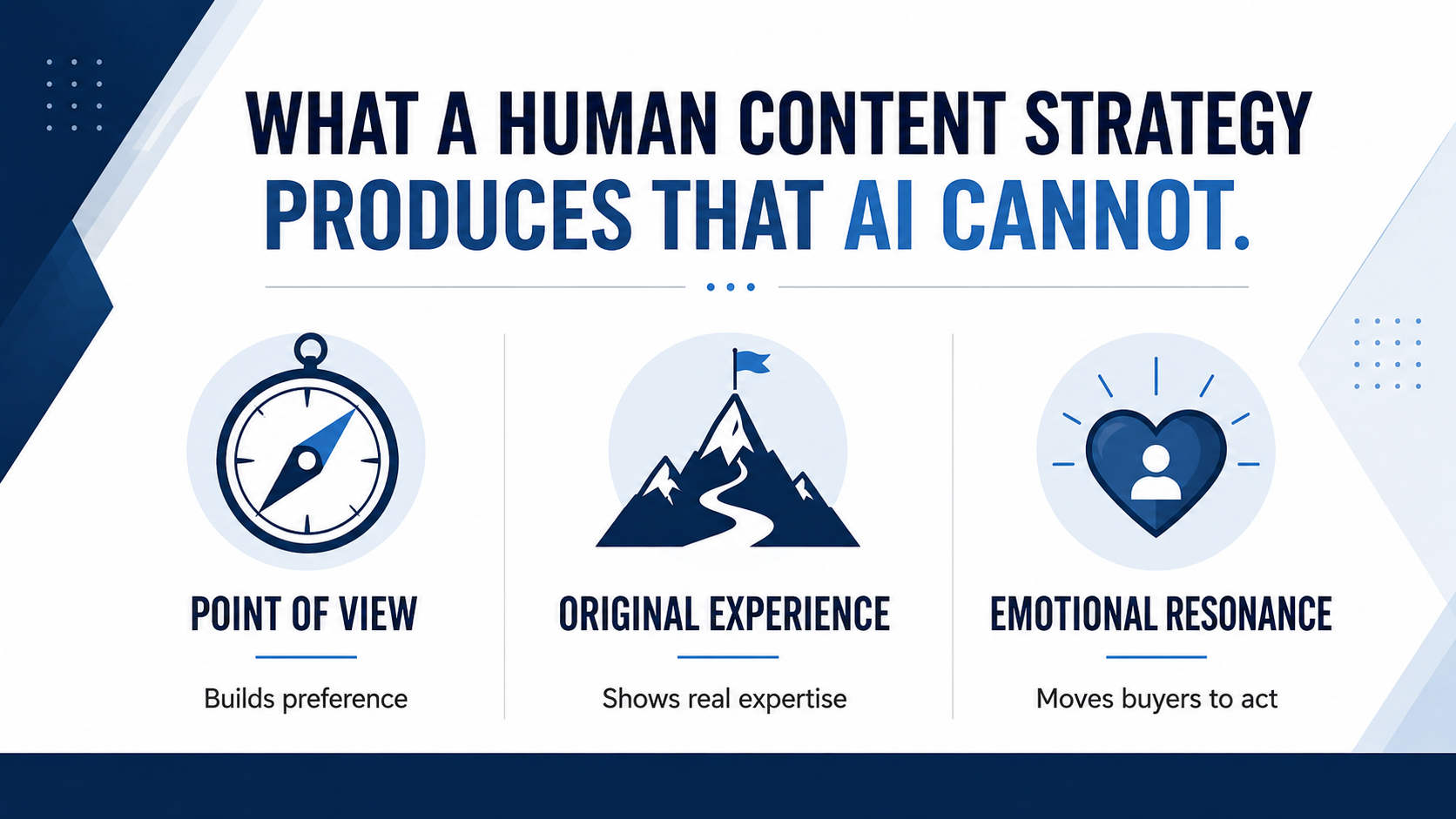
Human expertise creates the signals that help content build trust and move buyers to act.
When multiple businesses use similar prompts and datasets, the output converges. Topics get covered. Points get accurate. The content becomes interchangeable. A buyer reading it cannot tell who produced it, which means it does not build any preference for the brand that published it.
The Content Marketing Institute’s B2B research for 2026 found that businesses producing content without genuine expert involvement see weaker lead quality and longer sales cycles, even when traffic stays stable. The problem does not show up as a visibility issue. It shows up as a conversion issue.
The discoverability crisis AI volume creates
AI search platforms like ChatGPT and Perplexity now evaluate content on topical depth, author credibility, and genuine query resolution. They do not run a simple link graph. Generic content that covers a topic without adding original perspective or real expertise rarely gets cited.
A human content strategy built around demonstrated expertise earns citations. That is the visibility advantage that matters now, not keyword density or publication frequency.
What a human content strategy actually produces that AI cannot
The distinction is not about speed or volume. It is about what drives a reader to take action after reading.
Genuine point of view builds preference
AI synthesizes what already exists. It cannot hold an opinion based on lived experience, offer a perspective shaped by working directly with clients, or challenge conventional thinking from a position of earned credibility.
Content with a genuine point of view creates preference. Buyers remember a perspective that surprised them or confirmed something they suspected but had not seen articulated. Generic coverage of a topic leaves no trace.
Original experience signals the expertise buyers need to trust
Google’s E-E-A-T framework now includes Experience as its leading signal. Content that demonstrates real-world involvement in a topic performs better than content that describes a topic from the outside.
That experience signal cannot be generated. It has to be contributed by the people who have it. A consultant who has worked through a specific business problem, a practitioner who has run the campaigns, a leader who has seen the pattern across clients: their perspective is the content asset that AI cannot replicate.
The Content Marketing Institute’s 2026 trends research puts it directly: authenticity is the number one content asset businesses hold in 2026. The marketers who gather human expertise from their people and publish it consistently are building something that compounds over time.
Emotional resonance determines whether content moves buyers
Buying decisions are emotional. Buyers rationalize with data but decide with feeling. Content that understands the reader’s actual fear, frustration, or aspiration at the moment they are reading converts. Content that describes their situation from a distance does not.
AI does not experience the emotional context of a decision. It can describe it. Human writers who understand their clients deeply can write from inside it. That difference is what separates content that generates inquiries from content that produces pageviews.
The human content strategy gap most businesses have not closed
The CMI’s B2B research found that only 5% of employees with specialized knowledge actively contribute to content programs. That means 95% of a company’s real expertise sits outside the content it publishes.
The pacesetters in B2B content show 24% employee participation in thought leadership versus 18% overall. They also measure differently. Seventy-five percent of top performers track business impact from content, not just clicks. Fifty-one percent track brand authority. They treat their human content strategy as a business asset, not a traffic mechanism.
Organizations that have not closed this gap are essentially publishing commoditized information under their brand name. They look active. They do not look authoritative. In a market flooded with AI-produced content, authority is the only differentiator that creates real commercial preference.
The hybrid approach that actually scales
The businesses producing the strongest content in 2026 use AI for research, structure, and distribution efficiency. They use human expertise for strategy, perspective, and the final product. AI makes the system faster. Human judgment keeps the output worth reading.
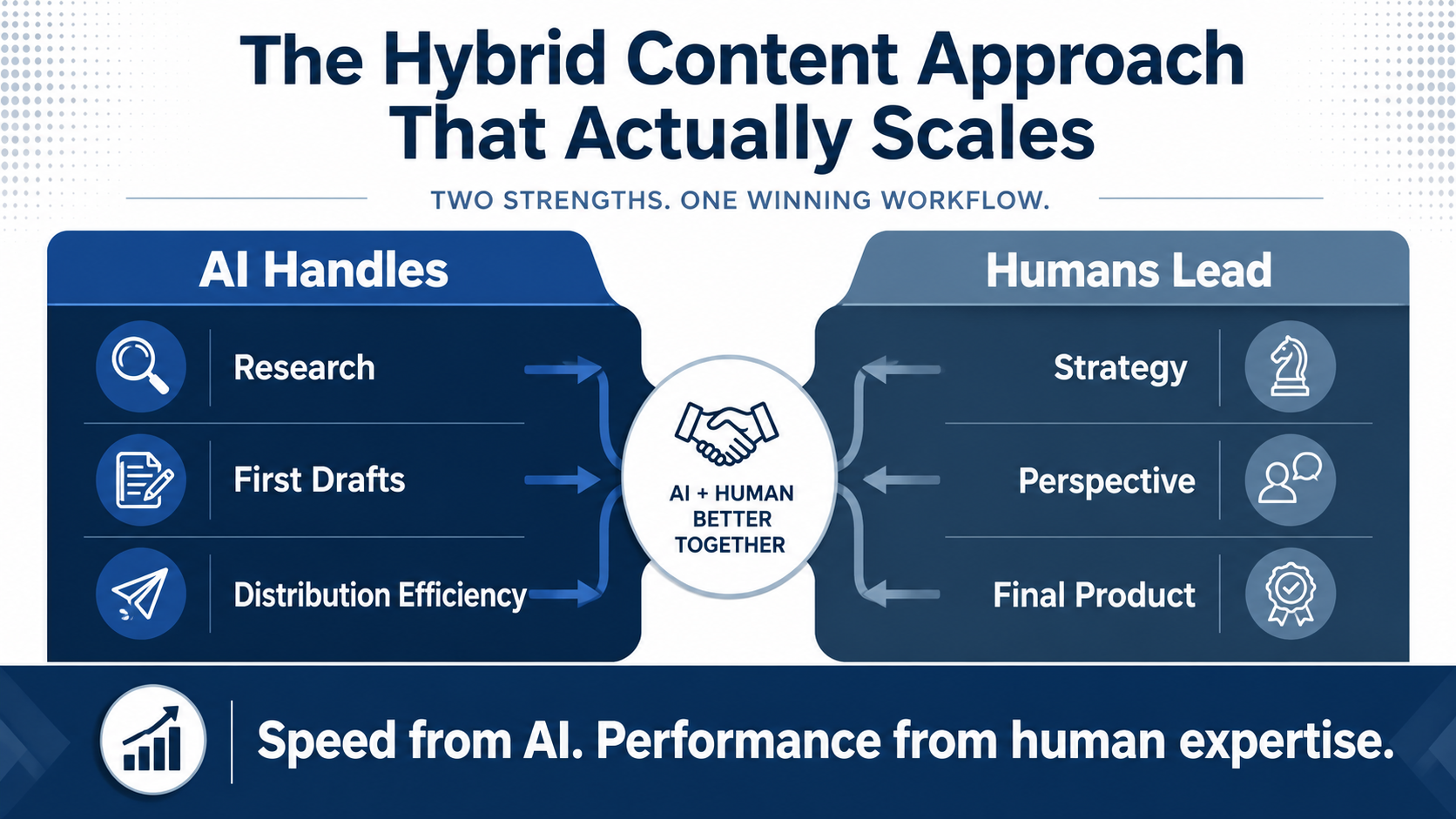
The best content systems use AI for speed and human expertise for performance.
That is not a philosophical position. It is a performance position. Human content strategy built on genuine expertise earns citations in AI search, builds the authority signals that drive organic visibility, and produces the conversion quality that justifies continued investment.
We covered the authority dimension of this in our post on what drives trust signals in AI search, and the content structure side in our post on how to optimize content for AI search in 2026.
How WSI builds human content strategies that generate leads
Building a human content strategy that converts requires more than a content calendar. It requires a clear picture of who the buyer is, what they need to believe before they contact you, and which formats and topics draw out the kind of genuine expertise that builds trust.
Our inbound marketing work builds content programs around exactly that structure. We start with the buyer, map the decision journey, identify where genuine expertise creates the most commercial influence, and build the content system that delivers it consistently.
Our digital strategy service connects the content program to revenue objectives, ensuring that what gets published serves a clear business outcome rather than just generating traffic.
For organizations that also want their content to perform in AI search environments, our Adaptive Search Everywhere Optimization ensures that the expertise built into the content also earns visibility across ChatGPT, Perplexity, and Google AI Overviews.
Frequently Asked Questions
What is a human content strategy?
A human content strategy is a content program built around genuine expertise, original perspective, and real experience rather than AI-generated volume. It prioritizes content that demonstrates the organization’s specific knowledge, builds trust with buyers, and earns citations in AI search environments where authority determines visibility.
Does AI have a role in a human content strategy?
Yes. AI handles research, first drafts, formatting, and distribution efficiency. It makes the production process faster without lowering the quality bar. The human contribution is strategy, perspective, and the final product. That division of responsibility is what allows content to scale without becoming generic.
Why does human-written content convert better than AI-only content?
Human content strategy converts better because it creates preference. Buyers choose businesses they trust, and trust is built through demonstrated expertise, genuine perspective, and emotional resonance. AI-generated content that covers a topic accurately but impersonally does not build that preference. It fills a page without moving a buyer.
How does human content strategy affect AI search visibility?
AI search platforms like ChatGPT and Perplexity evaluate topical depth, author credibility, and query resolution quality. Content with genuine expertise, original data, and clear authority signals gets cited. Generic content produced without expert involvement rarely earns citation in AI-generated answers. A human content strategy is therefore also an AI visibility strategy.
If your content is generating traffic but not the leads and conversions your business needs, the WSI team can help you build a human content strategy that closes that gap. Start the conversation here.
